January, with its Allure of Newness and Spaciousness

Once again, the time has flown by and it is almost three months since I posted here. Partly it’s because I’m writing so frequently on Substack, and partly it’s that the holidays took more time than I anticipated, no matter how much I tried to have a slower season. But I’ve been planning posts for you here as well and now that we’re into a new year, it was time to write and catch up with you.

I enjoyed a slow start to January, and needed about ten days after Christmas to catch up on sleep and calm myself down after weeks of activity and lots of stimulation. Do any of you feel this way after winter holidays?

Yet I also have this excitement about a new year beginning, even though I know we really can start something new or start over any time of year. I love to write down goals and plan out how to make them happen. And I like the discipline of a routine after a few weeks in limbo during late November and December. Below is a list of what I’ve been doing or thinking about, and what I’m planning in the next few months.

Re-committing to a Routine: This year, I plan to meditate and practice yoga every morning. And to work out and/or walk every day as well. I feel the need to be as strong, grounded, and healthy as I can be for whatever this year brings. And journaling every day is also one of my commitments.

Journals and Planners: Starting new journals and planners is such a joy each January. I’ve got several going for different reasons or needs. I recently shared a post about journaling on Substack, which you can read here (and do subscribe!).

  1. The Cycles Journal is to track my cycle, physical and emotional symptoms, moods, wellness routines, etc. This is my fourth year using this journal and I wish I’d had it in my twenties and thirties. I gifted one to my daughter and another to my niece in hopes that they’ll connect more deeply with themselves and their cycles this year.
  2. Molly Remer’s Prayerbooks on Lulu are what I use to write down spiritual things specifically such as prayers and poems, thoughts and questions.
  3. Woodspell Apothecary’s Planner is beautiful, spiral-bound, and connects me to the land, the moon and herbal medicine. It’s my third year using this planner and I love it more than ever.
  4. The Bullet Journal is where I write daily lists, goals for the month and year, and record other things such as favorites lists.
  5. We’Moon Planner is feminist datebook with artwork and there are poems and short pieces throughout that are read from during Molly Remer’s monthly circles.
  6. Leonie Dawson’s 2025 My Brilliant Year Workbook: Biz Edition is a good way to reflect on what worked and what didn’t in my business last year and how I want to do things differently this year.
  7. The Life Organizer by Jennifer Louden isn’t a journal, rather she offers weekly questions that are very helpful for women, especially busy mid-life women, to discover what they really need and how to make themselves a priority in the middle of it all.

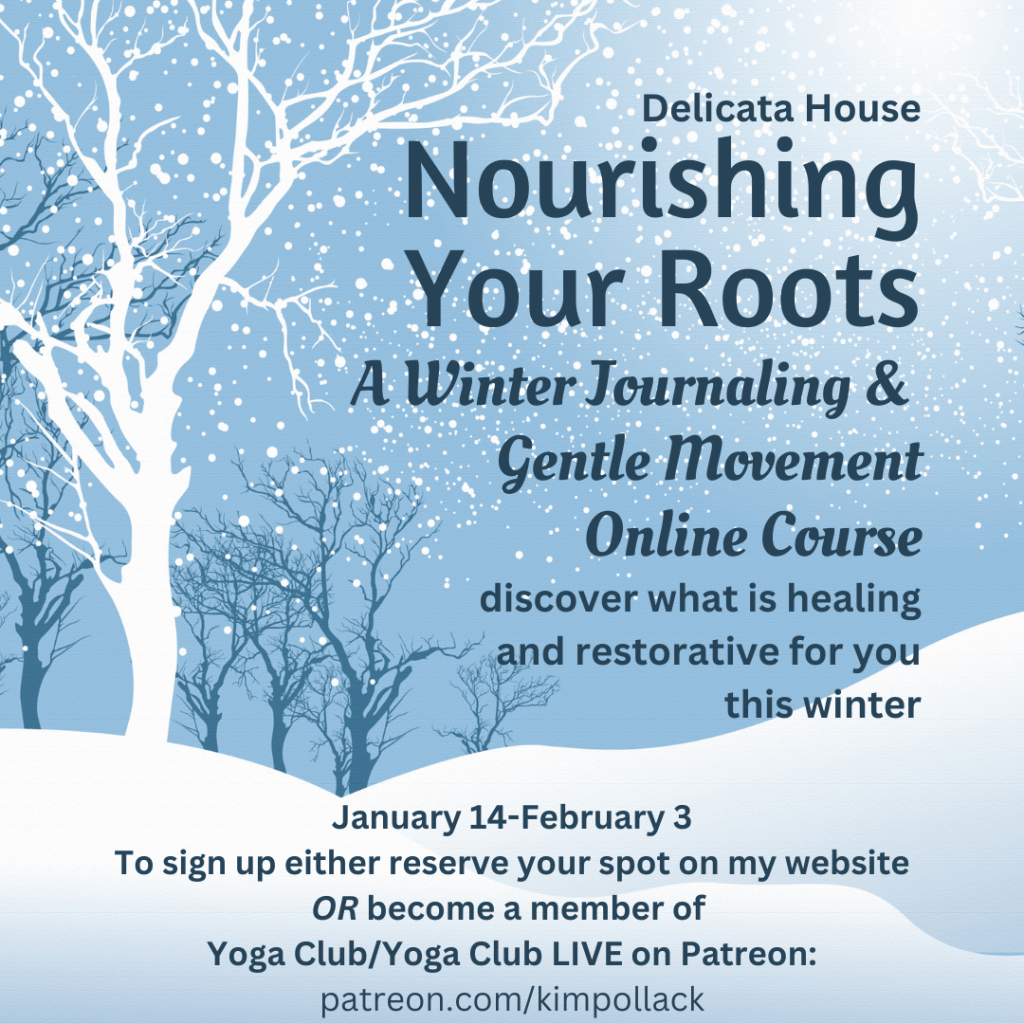
Journaling & Gentle Movement Course: I’m offering an online course called Nourishing Your Roots: discover what is healing and restorative for you this winter. It starts January 14 and goes through February 3rd. I hear so many people say they’re stressed, tired, sick, unmotivated, and don’t seem to have clarity about their lives and goals. Journaling is one way to get focused and clear on what you really need and want in order to heal and have a more nourishing life. And movement helps us connect with our bodies, supports our immune systems, and lifts our mood. If you’re a paid member of either my Patreon or Substack, this course is free to you. Or you can sign up on my website, here.
A few of the books I’m reading this month (because there are always more):

  1. This is Happiness by Niall Williams. I read Time of the Child just as Christmas was arriving and had to go back and read This is Happiness. So Irish, so full of characters that have a lot of life in them, such good stories.
  2. The Art of Possibility by Benjamin Zander and Rosamund Stone Zander. I’m reading this one for my Substack’s Book Club. You can subscribe here.
  3. Anne’s House of Dreams by L.M. Montgomery–I started reading through the series again in the late Autumn for comfort and to escape the harshness of the world scene.
  4. Wild Mercy: Living the Fierce and Tender Wisdom of the Women Mystics by Mirabai Starr. I am in love with her Prayer to the Shekinah in the beginning of the book.
  5. When God Was a Woman by Merlin Stone–all about the history of the suppression and destruction of the goddess religions worldwide. For someone who grew up in Christianity, there is a lot I never knew about the damage connected to even the roots of our faith. It is a lot to take in, but I’m glad to know what history tells us.
  6. Four Thousand Weeks: Time Management for Mortals by Oliver Burkeman. Yes, I still am finishing this one.
  7. American Detox: The Myth of Wellness and How We Can Truly Heal by Kerri Kelly. This one caught my eye and I purchased it on Kindle when it was on sale. So far, it’s worth reading.
  8. And I hope to start The Scent of Water by Elizabeth Goudge. This is one of the books I received as a gift for Christmas and one of my friend Laurie’s favorite novels. I’ve been meaning to read it for years! Let’s see how I do with all of these this month.

What I’m learning:

  1. How to watercolor with Liz Steel’s Foundations Course.
  2. How to use the Digital Pressure Canner my son gave me for Christmas.
  3. How to format a book for self-publishing to Kindle or Lulu.

Projects I’m working on:

  1. I want to make a few new scrunchies. One of my favorites broke the other day and I looked at it and thought, “How hard can this be?”
  2. I’m putting together a few new sets for my shop: a Winter Skin Care Box, an Imbolc/Brigid’s Day Box, and a Valentine’s Day Box.
  3. I’m brainstorming new courses to teach for Late Winter & Spring which may include yoga, Ayurveda, herbs, aromatherapy, journaling, and/or meditation.

What about you? What journals, planners or workbooks are you using this year? What are you learning or what projects are you working on? What are you reading this month? Please do share!

Comfort Yourself: It May Look Different Than You Think!

How are you feeling? If you’re in need of some comfort, nurturing, and uplifting, you’re not alone! I’ve been hearing this a lot lately. Maybe the winter has you down; perhaps you’re grieving the loss of any number of people and circumstances; and maybe you’re still processing “the lost years”, or still feel stuck in them due to worries about catching Covid.

 If you nodded your head to one or more of the above, I’m sending you a virtual hug. And I want to encourage you to comfort yourself. By this I mean to care for yourself in all the ways you need attention in body, mind, and soul. Good nutrition, exercise, prayer or meditation, enough sleep and rest, play/creativity, water, supplements, a bunch of flowers, a walk in the woods or around the block, connecting with your friends and loved ones, therapy, etc., are all ways to comfort yourself.

It’s easy, when we’re feeling down, to let all that go and just wallow, eat junk, drink too much, isolate, binge watch or obsessively scroll. We think we are comforting ourselves when we check out and self-medicate in some way.

Did you know that’s actually not comfort? Comfort means “to strengthen greatly”. And no strengthening is happening when we treat ourselves poorly–we’re weakening and abusing ourselves greatly instead. This actually makes us more fragile and less able to handle what is difficult in our lives.

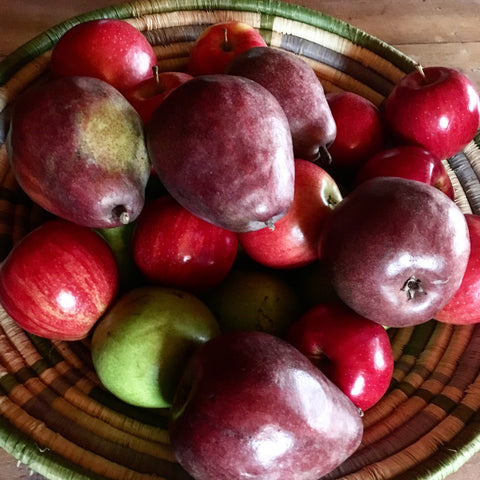
Bowl of pears and apples

We need to do what is life-giving for us. To love ourselves enough to prioritize our physical, emotional, mental, and spiritual health. I have to bring up the golden rule because sometimes people get tetchy about loving themselves, especially those with Christian roots or identities. Loving and serving others they can handle, but when they’re encouraged to love themselves it sounds self-centered. Um, it’s in the Bible, ya’ll. The second of the Ten Commandments. “Love your neighbor as…yourself!” There’s an assumption in that commandment that you love yourself before you go love your neighbor. 

So back to comfort. Ask yourself: In what ways am I in need of comfort (aka to be strengthened greatly)? How could I bring comfort into my life today in practical ways? What tools do I already have to strengthen myself? Where might I need help or accountability in order to care for/comfort myself?

Personal story: I am still dealing with the effects of Covid from six months ago. My brain is foggy sometimes, I tire out easily and get this trembly weakness in my legs and have to sit down. Sometimes I have to rest for a couple days in a row. Because of this, I hadn’t worked out as hard or as often as I’m used to. I’d work out one day and take three off–this was unheard of for me! I’ve been working out every day since I was twelve. I felt so bummed about how out of shape I had become, how weak I felt, how I’d lost stability in my core and mobility particularly in my hips. I kept waiting for things to get better. But they weren’t.

Snowy sunset

Then I listened to motivational speaker Brendon Burchard talk about making a Don’t Wait list and beginning to do the things I truly desired to do. And one of these things for me was getting in shape and feeling good in my body again. So I signed up for a challenging 4-week exercise program.

The first week was really difficult and I felt a bit discouraged because it was harder than I thought it would be. My brain tried to tell me it’s too hard, maybe I should quit, etc., but I stuck with it ( and kept listening to Brendon Burchard’s Motivation podcast for encouragement).

I’m nearing Week 4 and can feel my body getting stronger and firmer, my mobility range is growing, and I’m setting my sights on a 100 Day Program that I didn’t think I’d ever do again. And my confidence is higher because I’m keeping my word to myself and doing what I know is good for me to do.

This is an example of me comforting myself! It’s the opposite of what we might think of as comfort, right? Oh, and by the way, I didn’t overdo it, injure myself, or punish myself with exercise. This is a balanced program and includes rest days. I’m feeling better, so this is the right thing for me. 

Kim in workout clothes

I’m not suggesting you sign up for a challenging exercise program. Comfort could look like many different things, depending on what you need. Sometimes a cup of tea, a nap, a book or Netflix, and a blanket is the comfort we need. My point is, if you’re feeling down, or are in a difficult season, take a look at your daily routines/habits and see how you might care for yourself. Being good to yourself will help you feel as good as you possibly can during whatever you’re going through. I hope you find the comfort you need!

Setting Intentions for Your Home and Your Life (Wellness Wednesday)

Outer order contributes to inner calm.” Gretchen Rubin

Have nothing in your house that you do not know to be useful or believe to be beautiful.” William Morris

Good Intentions

There are so many wellness habits we may be working on this fall to improve the quality of our lives: sleep, exercise, or mindfulness, or diet. It is absolutely necessary to build these healthy habits for living your best life. Today, though, I want to focus on another area that is just as personal: your home.

Your living space should reflect the kind of life you want to live. This means being intentional about what you want your life to look like. Have you ever spent time visualizing the home you want to live in? Have you written down words that reflect how you envision it? Do you want a warm, welcoming peaceful place to enjoy your life, and time with family and friends? Do you want to feel at ease and comforted whenever you walk through your door?

I set my intention years ago when I decided that I wanted my home to be peaceful and comforting to me so that I enjoyed being there every day, and so that my family and friends wanted to be there too. And I highly recommend that you take some time to think about the kind of life you want at home and write down a list of ways you want it to be. Stick it to your fridge door or inside a cabinet door so you can see it often.

Two Habits

Since I wanted a peaceful, comforting living space, I had to form two habits: 1. I had to clean my house regularly (bathrooms, kitchen surfaces, dusting, vacuuming, mopping), and 2. I had to regularly tidy and get rid of things I no longer used. This second habit is the key to easy, fast cleaning and an organized, tidy home, and it actually comes first.

Until I met Alan and moved into our very large 1850s house, I always lived in small apartments and houses with not much room for storage. So I got used to looking over my belongings and giving things away/taking things to Salvation Army every month or so. My mom did this regularly and I saw the wisdom in it. I always have a bag started with things we are finished using, wearing, reading, etc.

The More Stuff You Have, The Harder it is to Clean

You might think cleaning your house once a week is impossible, but what is behind the resistance? Does the task seem overwhelming to even think of? Is the overwhelm related to the amount of stuff you have accumulated in your home?

Think of the top of your dresser, for instance. Is it covered with stuff? Piles of clothes, bottles of makeup, loose change, trinkets, and knick-knacks? Do you find it easy to dust that dresser top? How often do you get around to it? I’m guessing if it’s covered with stuff, you don’t get to it often because it’s such a pain to take everything off to dust it. 

If you were able to put all the clothes where they belonged, put your bottles in a basket, and maybe just had 1-3 knick-knacks displayed, it would be a breeze to dust that dresser! To quote the title of Mari Kondo’s book, it really is life-changing and magical to tidy up.

Litmus Test for Tidying

Do you know what you own? I like to be able to locate anything I own without searching for it. When I can’t find something, I know it’s time to spend a few days tidying, and getting rid of things I don’t need anymore. This allows room for what is coming next in my life. If I am holding on to stuff I no longer need or use, this is symbolic of holding onto the past and not being willing to move forward in life. I don’t want that! No matter how good the past was, I want to have room in my life for the goodness and abundance that is coming next.

How to Tidy To Change Your Life

Marie Kondo recommends focusing on one category at a time. And if you have a whole day at a time to do this, then go ahead. Gather all the clothing in your home, pile it on your bed, and start deciding. But if you have a busy life, are a chronic pack rat or just don’t like to clean or tidy, I recommend focusing on one room at a time.

For example, start with your bedroom. And then break that down into manageable bites, like doing one dresser drawer each day. Then move on to your closet and do the top shelf first, and work your way down, one day at a time. After a week or so, depending on how many drawers and shelves you have, you’ll have a whole room done.

If you do it the KonMari way, she has you pull all the things in one category (like clothing) out from the space you’re going to tidy and hold each item in your hand. If it sparks joy, it’s a keeper; if it doesn’t, you can give it away to a friend or to goodwill, sell it, or recycle it.

After you’ve gone through the clothes from one drawer and decided what to keep, you can learn how to fold them using the KonMari Method: I learned this on Youtube. There are videos here and here. Even underwear and socks can be folded neatly!

When you first learn to fold this way, it will seem slow and awkward, especially if you could win a lifetime messy folder award (like me). But once you experience the thrill of opening your drawer and seeing all of your clothes at once, you will never go back to just stuffing stacks of clothes into a drawer. It actually is a timesaver!

Cleaning is Easy Now

Once you’ve gotten rid of excess stuff, you can tidy daily and pick a regular day or night to clean. If you have kids, they should each learn to tidy and clean; you’ll teach them healthy habits that will benefit them their entire lives.

On cleaning day, I like to do my bathroom and kitchen surfaces first, then dust furniture and shelves, vacuum, and mop. People often think because my home is clean that I enjoy cleaning. The truth: I don’t! But I do enjoy the result. And I like the sense of control I feel. I may not be able to change certain things in my life today, but I have control over the beauty and order in my home. And you do too!

If you’ve tidied using the KonMari Method, or some other way, share about it in comments!

My Favorite Books About Tidying and Housekeeping

Outer Order, Inner Calm by Gretchen Rubin

In this book, Gretchen shares 9 reasons why you want a clean, well-ordered living space.

The Life-Changing Magic of Tidying Up: The Japanese Art of Decluttering and Organizing by Marie Kondo

This is the classic that everyone should read. Marie shares her revolutionary method with plenty of how-tos.

Organized Simplicity: The Clutter-Free Approach to Intentional Living by Tsh Oxenreider

I read this as a young mom and it was very helpful for me to be more intentional with my home and family. She has helpful forms you can use and many natural cleaning recipes. If you are a parent, read this book!

Home Comforts: The Art & Science of Keeping House by Cheryl Mendelson

This is like the bible of housekeeping. If you need to know how to iron something, how to get a particular stain out of a tablecloth, how to clean every kind of surface you can imagine, or why you should even clean in the first place—you will find it all within these pages. I read this as a very young person and think every home should have a copy.

Aromatherapy Blends

Cleaning Day Blend

Place drops in diffuser, fill with distilled water and diffuse for 1-3 hours

2 drops Bergamot 

3 drops Lemon

2 drops Cedarwood

Aromatherapy Mopping Blend

Apply drops to bottom of steam mop or spray mop

6 drops Lemon

3 drops Tea Tree

2 drops Lavender

Courage, Dear Heart (Wellness Wednesday)

We were getting ready to drive to a music gig near Keuka Lake, filling water bottles, ironing clothes, and packing snacks when I spotted the mail basket. I rifled through the pile and came across a letter addressed to me from the U.S. District Court. Oh no!!! (Oh, yes.) It was a jury summons–but this was worse than usual: for a period of at least a year, several times per month, an hour and a half drive each way.

At the moment I felt like freaking out, but we had a three-hour performance that afternoon, so I read it over once and set my freak-out aside until after our show. By the evening, my chest felt tight, by the end of the next day, I had a sore throat and my shoulders and neck were sore with tension.

I filled in the online questionnaire and gave a valid excuse why I couldn’t serve (my business can’t survive without me), but I have to wait three weeks to find out if I still have to go.

So, now I have a choice to make: I can live each moment until then in fear, worry, upset, dread, and panic, or I can find ways to act and think differently–with positivity, joy, and courage.

Gretchen Rubin’s Third Commandment from her Happiness Project is “Act the way you want to feel”. Does that seem too much like “Fake it till you make it”? But think about it: Where will those good feelings come from if we don’t take the energy we have and transform it into something better?

If you don’t happen to wake up happy and positive each day, do you just let that dark cloud of gloom hanging over you ruin your whole day? I’ve absolutely been guilty of this. I’ve also had days where I wake up super negative but do the things I know will propel me out of my funk.

The first scenario is a passive one: I just go with whatever happens, just feel whatever feelings I feel and act however I feel. The second scenario is active: I take what I have and make something better out of it. Do you know these are both decisions?

You and I can either decide that we will let our feelings run us OR we can decide that we will run our feelings. You are more powerful that you realize! You have the power to make or break your day!

But what about if you’re already an anxious person (like I am) and you happen to be in an extremely anxious season? The Fall seems to heighten anxiety for me and I know I’m not alone. We don’t have to take it! (Does this remind you of a certain Twisted Sister song?)

I wanted to share a list of things that help me calm down. Some of these I am learning in Ayurveda School, some of them I’ve learned in the HSP class I’ve been taking, some I’ve learned as an aromatherapist, and some I’ve discovered on my own. They all help, but there’s just one catch: We have to actually do the things!

Get up before the sunrise.

Practice meditation/pray.

Journal and write your manifestations. (Listen to Rachel Hollis in this podcast episode on why.)

Visualize how you want your day to go, walk through any known difficulties and decide how you will handle them. (Thanks, Brendon Burchard, for your awesome High Performance Planner!)

Develop a daily yoga practice. It could be 5 minutes or 90 minutes, but practice. There is nothing else like it for calming the mind, connecting the mind and body, and grounding you.

Drink herbal tea/coffee substitute. You know what? I don’t love most herbal teas, but I drink it because it calms me down. Lemon balm has been daily go-to. However, I just found a new caffeine free gluten free herbal tea that satisfies my coffee craving without the jitters. If you’re a coffee nut like I wish I could still be, you gotta try it: Teeccino Dandelion Coconut Roasted Herbal Tea.

Go for a walk outside. I always feel refreshed and my nervous system feels soothed when I do.

Eat lots of plants.

Have a gratitude practice. This could be in your journal in the morning or at night.

Keep a positives journal. This is new to me, but the teacher of the HSP class said sensitive people focus on the negative too much and need positive things to keep them grounded. Make notes of what good things happen in a day, things you love, moments of happiness, and then read through these when you’re feeling anxious.

Read poetry. YES!!! If you think you don’t like poetry, start with children’s poems and approachable poets like Mary Oliver and David Whyte. Poetry speaks to and nourishes the soul, the emotions I would say that if you’re a sensitive person, like I am, you may not be able to read some poetry that tends to be chaotic, angry, and violent. I tend to gravitate toward poems that express reverence for nature and that speak to the inner life of a person. These are a good place to begin:

Devotions by Mary Oliver

The House of Belonging by David Whyte

Favorite Poems Old and New by various

Get enough sleep.

Get a massage whenever you can and do self-massage daily. Even if you don’t get to a full body self-massage every day, which I highly recommend, at least do a foot massage right before bed. Some warm sesame oil and a drop or two of Lavender essential oil massaged into your feet will send you into blissful slumber.

Practice positivity. Focus your thoughts and speech on “Whatever is true, whatever is noble, whatever is right, whatever is pure, whatever is lovely, whatever is admirable if anything is excellent or praiseworthy think about such things.” This is found in Philippians 4:8.

Spend time processing your day: thinking about and journaling about it. According to my HSP teacher, sensitive people need about two hours of alone time each day.

Take one day off per week. Does this sound impossible? I know, it’s pretty difficult for me as well. When I do it, my life is better. We all need adequate rest and time for recreational pursuits. Work on this one and I will too!

Use an aromatherapy diffuser near your desk while you work and in your bedroom at night. Turning it on for an hour or two at a time is a wonderful way to calm down your mind, emotions, and your whole body. Calming essential oils like Lavender, Roman Chamomile, Black Spruce, Cypress, and Mandarin are a few to try, either individually or blend a few together.

That’s my list. I hope you find some useful tools to help you handle bouts of anxiety. I would love to hear about what things help you when you are feeling anxious.

And, finally, here is an aromatherapy blend to use in your aromatherapy diffuser.

Calming Blend For Anxiety

1 drop Vetiver

2 drops Black Spruce

2 drops Red Mandarin

3 drops Lavender

PS: Today’s title was taken from The Voyage of the Dawn Treader by C.S. Lewis: “But no one except Lucy knew that as it circled the mast it had whispered to her, “Courage, dear heart,” and the voice, she felt sure, was Aslan’s, and with the voice a delicious smell breathed in her face.”

The Art of Attentiveness (Wellness Wednesday)

This week, for Wellness Wednesday, I’m focusing on attentiveness. Charlotte Mason, my homeschooling mentor, called it “The Habit of Attention”. Many call it mindfulness. If you’re thinking, “What does this have to do with wellness?”, that’s a great question because it means you are paying attention and letting curiosity get the better of you!

What started me thinking about paying attention is this online class for HSPs (Highly Sensitive People) that I’ve been taking. I’m learning lots about how to thrive rather than simply survive as a person who processes life differently than most. I’m discovering what my strengths and weaknesses are as a person with this trait and how I can navigate the high levels of emotion that come with it, how I can conserve and replenish my energy, and how to ask for what I need. 

It’s kind of crazy that it’s taken me this long in my life journey to begin learning these things, but as the saying goes, “When the student is ready, the teacher will appear.” And one thing that stands out from this class is that in order to implement my newly acquired tools and techniques, I need to learn to pay more attention.

It Starts With Me

First, I need to pay attention to myself. This is a bit of a challenge for me because I lived most of my life in a culture that was all about service to others. I still absolutely believe in service to others, just not in a way that leaves me completely out of the equation. Even Jesus said, “Love your neighbor as yourself”, which implies self-love. 

I need to ask myself, “What do I need?” when I’m starting to get tired, upset, overwhelmed, etc., rather than to just keep going until I get to meltdown mode. And “Do I have this to give?” when someone asks something of me. If I’m already in a depleted state, I’ll be giving from a negative, resentful place. If I can live from a place of love and compassion toward myself, I’ll be much more loving and compassionate toward others.

Focusing on the Good in Others

Second, I need to pay attention to others. And by this I mean to focus on the positive qualities that each person has. HSPs can nitpick, obsess, and tend to focus on negative things, especially when tired and emotionally overwhelmed, which is a lot of the time if we aren’t paying attention to our needs. I need to make lists of the good things about those I love and know and repeat those things to myself and say them out loud to them. 

By sharing the things I admire and appreciate about others with them, it will encourage them and reinforce the truths about who they are in my own brain. When I’m with my husband, my kids, or my friends, I need to focus on their words, on their faces and gestures, and savor the moments we have together.

Nature

Third, I need to pay attention and connect with nature. Put on my shoes, step out the door, look, listen, breathe, feel, and notice. What do I see? What sounds can I hear? Does the sun feel hot on my back or the wind feel like it’s pushing me while I walk? What kind of bird is singing in the apple tree? Where is that tang in the air coming from?

Slow Down

And this is the kicker for me: In order to cultivate the art of attentiveness to myself, others, and to the world, I NEED TO SLOW DOWN!!! My smart husband is always telling me this and until I started this class, I inwardly resisted. “But I have so much to do! I’ll never get things done if I move around like a snail.”

During week one, the teacher said, “HSPs need slow mornings”. She said if you start the day off at a clip, your emotional brain revs up, is on high alert, and you quickly lose “energy points”. That explains why I’ve been tired within a few hours of waking up for most of my adult life.

At my teacher’s suggestion, I’ve begun a daily meditation and mindfulness practice. Waking up and meditating first thing in the morning has been a huge help to me this past month. I used to jump out of bed and start on my to-do list, but now I take a few minutes to pay attention to my breath and that sets the tone for the rest of my day. It’s training me to notice my needs so that I don’t overextend myself emotionally and physically. I can give to my family, work better, and still have energy left to enjoy life. And this is living well.

Books

Want to read more about slowing down and paying attention? Here are two non-fiction books on the subject plus a book of poetry that you might be interested in.

The Art of Noticing by Rob Walker

Lost In Wonder: Rediscovering the Spiritual Art of Attentiveness by Esther de Waal

Thirst by Mary Oliver

Blend

And here’s an aromatherapy blend that will help you focus and cultivate attentiveness. Place drops in diffuser, fill with distilled water, and diffuse for 1-2 hours at a time. Best during the daytime hours.

1 drop Cardamom

2 drops Cedarwood

3 drops Lemon

If you would like to tell us how you’re learning to be more attentive, please share in the comments!

Moving Toward Morning

We just finished the first week of September and I feel all the things: a little melancholy that summer is waning, excitement for the start of a new season, and the sense that I am myself as this is my birthday month. Transitions–endings and beginnings blurring together–are always difficult, even when you are looking forward to the new.

I don’t know how the weather is where you live, but here in the Finger Lakes Region of New York, we are experiencing pleasant weather in the high 60s to mid- 70s (Fahrenheit). Although it still is warm, there is a tinge of a chill, and the nights fall a little earlier with each passing day. My daughter began eleventh grade this week, my stepson twelfth grade, and I am in my second month of Ayurveda school.

How I start my day determines how successful the rest of it will be, so I wanted to talk about morning routines. What does yours look like? Mine varies quite a lot. On Sunday, my wake-up time depends on whether my husband and I have a music gig or not, but most of the time I can sleep in.

Monday through Wednesday during the school year, I get up to drive my daughter to school. My choice is to either get up at 7 and launch directly into making breakfast/coffee/tea, and then drive her to school, or I can get up early at 5:30ish and meditate, journal, practice visualization and affirmations, exercise or do yoga, shower, and then start making breakfast, etc. The latter is my ideal.

Even the rest of the week–Thursday through Saturday–if I get up early and get all of those important soul-nourishing pieces of the morning done before the rest of the house wakes up, I feel amazing! I have a positive outlook, feel confident, and am ready to face the day. This way I can begin work, meet the needs of my family ,etc., without resentment or trying to figure out how to squeeze in a workout.

It might seem crazy to contemplate getting up an hour or two before everyone else. That obviously means going to bed earlier. As a certified lifelong night owl, it is challenging for me to stick to this. And I am not religious about it. If I don’t have a good night’s sleep, am not feeling well, or if I go to bed late because of work or a special occasion, I don’t get up super early and I don’t beat myself up about it. But as soon as I can realistically get back into my morning routine, I will.

So my hat is off to you if you’re already an early bird and rise before the sun to do what you need to in order to make your day a success. But if you’re like me and are still moving toward your ideal morning, that’s great too! The best thing is to ask yourself why would you want to do this and then write down a good long list of reasons why. The more reasons you have, the more likely you will continue working toward your goal. If you can display your list of reasons somewhere visible to motivate you, all the better!

Design the morning that works for you, at this stage in your life. And like I said in my Facebook and Instagram Lives on this topic, please, if you’re a young mom with a baby or toddler, or you’ve got an elderly parent or sick family member you are caring for, or anything else that is super demanding, this is not the time to begin a new routine, to get up early, etc. Be extra gentle and kind to yourself and take time for yourself when you can.

This particular advice comes from this episode of Gretchen Rubin’s The Happier Podcast: In order to get your family on board when you are starting new habits, be consistent! They will get used to it sooner if you stick to your routine.

And since I am always looking for ways to share what I learn about aromatherapy with you, here are two diffuser blends that are great for mornings. They are motivating, positive, promote confidence, perseverance, and a bright outlook.

Morning Blend 1:

1 drop Basil

2 drops Cedarwood

3 drops Lemon

Morning Blend 2:

1 drop Tulsi

2 drops Cedarwood

3 drops Orange

Alright, I’d love to hear about your morning routines: what works, what doesn’t, and what new habits you’re incorporating into your life this September.

Girl, Stop Apologizing! (Book Review)

Have you read anything by Rachel Hollis yet? Have you listened to her Rise podcast? If you’re an entrepreneur–particularly a woman entrepreneur, you need to read this book. If you’re someone who dreams of something more, but is afraid to try, this book is for you. If you have goals, but are in “the dip”, as Seth Godin so aptly named the space and time in between starting and finishing, you need to grab a copy of Girl, Stop Apologizing.

What I love about Rachel Hollis is that she has been at the bottom, but she had dreams and goals like a lot of us do, but she didn’t quit. She didn’t give up. This woman has drive and she knows how to focus on what she wants and does not give up though all the disappointments, all the setbacks, all the negativity that would crush most people. She’s not superhuman, she’s just dedicated, and she shows us how to go after our goals.

There is practical, usable advice in every single chapter of this book, but not one word is dry or boring. You won’t find your mind wandering or read it just because you know you should. Rachel is a great writer! She is hilarious, outrageous, and unexpected.

Another thing I love about her is her honesty. She shares deeply personal, even humiliating stories from her life experience because she wants us to know who she is, where she’s come from, and how she got to where she is now. She does not hold back and because she’s so real, she builds trust with her audience, and makes us listen to what she has to say.

Rachel comes against the patriarchal ways of thinking that have held women back for thousands of years. She addresses downright lies about what women are for, how women should behave or what we should want out of life. It is very liberating, life-giving language that, even in 2019, women (and men!) need to hear.

Her chapter “Choose One Dream and Go All In” or “Ten Years, Ten Dreams, One Goal” is worth the price of the book alone. In this chapter, Rachel explains exactly how to go after your dreams. This is priceless information! Her chapter “Planning”, about reverse engineering your goal, or starting with the end in mind, was another chapter I found extremely practical and helpful.

So, yep, it’s another highly recommended, “You Need This Book in Your Life”, book review. Get it on Amazon or your local bookstore or public library, but definitely put this in your TBR pile for this year!

Starting Over with Habits

ADCCC87C-A1B2-4624-8BD0-ECB6933F8B8F

I know when I’m productive. I love the rhythm of daily practice once I’m steadily engaged in healthy habits. I thrive with the structure as well as the encouragement I feel from the momentum as I build on a skill day by day.

You know how life tends to derail us all at one time or another. And for me, when one habit falls by the wayside, I feel so much like a failure I tend to let others slip out of focus as well. Before I realize it, I let weeks go by without doing the things I know keep me sharp and challenge me to greater things.

Here is a list of some habits I have made my own:

Morning Pages

Bullet Journaling

Practicing Piano

Blogging

Gratitude Journaling/Being Thankful

Exercise

Reading

Taking supplements

Walking

Taking Photos

D7790ECE-7BF7-430E-AB05-76BE644F3779


After a season of upside down, I am returning to a sort-of normal and incorporating these back into my daily life. It makes me feel like I’m a worthy and useful human. Getting up early, going to the gym, doing Morning Pages and updating my bullet journal, and generally accomplishing good and healthy things help me function well throughout my day.

If I know I exercised, I can check it off my list, plus my body is less likely to feel stiff or sore if I got my heart rate up and body warm with cardio, did some resistance training and stretched afterward. If I took my supplements, particularly my B vitamins and my probiotics, I’ll have more energy and digest my food better. Practicing piano relaxes me when I’ve been writing or working at some other task for too long. Getting outside for a walk when I’m stressed or just to think a little brings me new perspective and reminds me how small my problems are when think about the vastness of our planet and space. Making time to read, fills my mind with other people’s voices, points of view, stories and ideas, so I get out of my head and learn. Practicing gratitude helps me rise above the melancholy I tend to fall into as an INFJ.

0EC04B68-A485-45D3-83BB-B4CCF7A4F466

Do you have a list of habits that help you live better? I’d love to hear from you!

Day 26: The Hurrier I Go

IMG_1474

I’m sure you’ve heard this Lewis Carroll quote,

“The hurrier I go, the behinder I get.”

There’s a certain point at which that becomes true. Not that I am encouraging dawdling or procrastination, but hurrying hurts and usually winds up hindering our progress. Oops! I spilled something in my haste. Or, now I need to apologize for snapping at my loved one because I’ve made myself miserable trying to live at this breakneck pace.

We weren’t meant to flit and speed from one place and activity to another with no rest, no time for reflection. Here is a definition of the phrase “hurry sickness” coined by doctors Meyer Friedman and Ray Rosenman:

“a continuous struggle and unremitting attempt to accomplish or achieve more and more things or participate in more and more events in less and less time.”

This article on how to overcome hurry sickness takes a good look at the problem. We need help! As a culture, many of us don’t know how to relax or slow down, even if we only have a few pockets of time every day.

We have forgotten how to love stillness and silence, how to sit with ourselves alone and just be, how to fully enjoy a walk, appreciate the preciousness of a loved one’s smile, drink in the exquisiteness of a sunset, how to be silly and laugh long and hard, and how to look for joy in the ordinary. But we can slow down and become full of wonder again.

IMG_1403

This time of year, you’re probably looking ahead at the next two months wondering how you’ll get through all the activities associated with the holidays. I used to just square my shoulders and tell myself to hustle more.

And I would go through it all feeling panicky, breaking down into crying jags, yelling and being sharp with my words. And then apologizing for my unacceptable behavior. I just couldn’t handle the constant go-go-go, combined with baking like mad, lots of entertaining, the purchasing and wrapping of gifts and trying to make it all magical and perfect for my kids and anyone who came to our home.

I wanted the peace I attempted to give everyone else. I craved space, simplicity, and the beauty of delighting in small things.

img_1620.jpg

After a bunch of years doing it the hard way, with the help of books or articles I read and voices on slowing down, like Ann Voskamp’s, I am learning to change my holiday style.

Here are a few questions you might ask yourself before plunging into the season:

If I could arrange my holiday season any way I chose, what would it look like?

If I wasn’t concerned about anyone’s judgement about how I did the holidays, what would I say yes to and what would I say no to?

Who is most important to me and how can I focus on showing them love this season?

img_0046


Here is an old book that I love called Unplug the Christmas machine: How to have the Christmas you’ve always wanted. It touches on typical roles that women and men take on during the holiday, four things children really want for Christmas, a simple Christmas, Christmas revival, the gift of joy, and it includes a handy resource section with recipes and alternative gift ideas. Of course, it feels dated, but it also feels wise and warm and cozy. Some of the resources may be outdated, but use the internet to find something comparable. This version is out-of-print, but amazon Marketplace has copies available.

And if you’d rather have the in-print version, that’s Unplug the Christmas Machine: A Complete Guide to Putting Love and Joy Back into the Season:

The other book I’ve read over and over is: To Dance With God: Family Ritual and Community Celebration. Although I’m not a Catholic, I incorporated several of the traditions listed in this book to enrich my own and my kids’ holiday season. This book actually takes the reader through the entire church calendar, but I’ve used it for Advent and Christmas, primarily.

And finally, a sweet out-of-print old-fashioned book called The Child’s Christmas. I’m not sure how I stumbled across this one, but it follows a fictional Victorian family from Advent through Epiphany. It tells of all their traditions, what they ate and played and did, what gifts they gave and received, how they celebrated. I read it to my kids when they were seven and three.

I hope we can all find comfort and joy this year!

IMG_1400


Day 19: Flow and NaNoWriMo


1CBABC93-BDCF-4020-B2F9-85382DB7E6CEAccording to Wikipedia, “In positive psychology, flow, also known as the zone, is the mental state of operation in which a person performing an activity is fully immersed in a feeling of energized focus, full involvement, and enjoyment in the process of the activity. In essence, flow is characterized by complete absorption in what one does, and a resulting loss in one’s sense of space and time.” ( Read more at wikipedia about Flow. )

And that’s what I got into today. Four or five solid, uninterrupted hours of totally absorbing, fulfilling and satisfying work throughout the afternoon gave me such a sense of accomplishment. Mostly because I haven’t had this lately and have felt frustrated about it, it felt particularly great. I sewed continuously and everything worked. or once, no stitches to pick out, no epic fails. I just made lots of cute things and cut out shapes for more.

Although I haven’t read his book Deep Work: Rules for Focused Success in a Distracted World yet, I’ve heard Cal Newport interviewed on Todd Henry’s The Accidental Creative Podcast and know I struggle with focus and steering clear of distractions. This book is on my Kindle and I need to read it ASAP.

Here is a blog post by Srini Rao about Flow and Deep Work and ways he has oriented his own life toward this way of working.

Speaking of Flow and Deep Work, I am gearing up for NaNoWriMo, or National Novel Writing Month. I need to announce my novel on their site soon and am petrified. Has anyone ever participated in this or attempted it?

I’d love to hear your thoughts on flow and deep work experiences and anything you know about NaNoWriMo.

197E93A1-9277-4DD8-8DA4-D059CF30D749