Last night, we had our first FLX Literary Society meeting in our library. There were five of us, which felt perfect, since four of us were introverts. This idea has been brewing ever since that episode of What Should I Read Next podcast where Tiffany talked to Anne about her Literary Society.
Tiffany was flooded with DMs on Instagram of eager readers, like myself, who wanted to know more about Literary Society and how to start one of their own. Thankfully, Tiffany graciously gave us some guidelines in her Instagram highlights and was very encouraging to those of us who wanted to take her idea and run with it.
So I did. I asked a few friends if they would be interested, started a Facebook page, and set the date for our first meeting. And last night, we met and shared all of our bookish thoughts with each other.
Alan went first and talked about 11/22/63 by Stephen King, which he just finished, and also about King’s Dark Tower series, which he loved.
Susan shared a few Shel Silverstein poems from A Light in the Attic (Somebody Has To and The Little Boy & The Old Man as well as an original piece of her own writing. Susan is a witty, funny writer and we all can’t wait until she has a blog of her own!
Jenny introduced us to The Art of Racing in the Rain by Garth Stein, a novel told through the dog’s perspective. She said this book will make you cry, but has a happy ending. She also told us about Travels by Michael Crichton, which was a travel memoir from his younger years, and The Weight of Water by Anita Shreve, which is a mystery set in Maine that alternatives between time periods. The book she’s reading now, The Second Mountain: The Quest for a Moral Life by David Brooks sounded like a good personal growth book and reminded me of Richard Rohr’s Falling Upward.
I talked about The Clockmaker’s Daughter by Kate Morton, that I finished earlier in the week. The writing in this book is beautiful. I wanted to read whole passages over again just to listen to the those words. Her writing reminds me a bit of Amor Towles’ A Gentleman in Moscow. The stories in this book are centered around a house in the English countryside where a ghost resides. Many characters from different time periods are all connected in some way to this house. The ghost’s narration is interspersed with third person POVs of the various characters in their various time periods. It was an ambitious book to take all of those people and find a way to connect them to the house. I thoroughly enjoyed listening to the audio version.
I also shared about The Heart’s Invisible Furies by John Boyne, a book about a gay young man growing up in Catholic Ireland during the fifties and sixties. And I talked abut She’s My Dad by Jonathan Williams, a book I’ll share more about in a review next week, and about the most bizarre book I read in 2018: Convenience Store Woman a story told from a socio-path’s perspective by Sayaka Murata.
Check out our Facebook page for video snippets and photos of our first meeting! Have you ever thought of starting a Literary Society? I’d love to hear from you in comments!
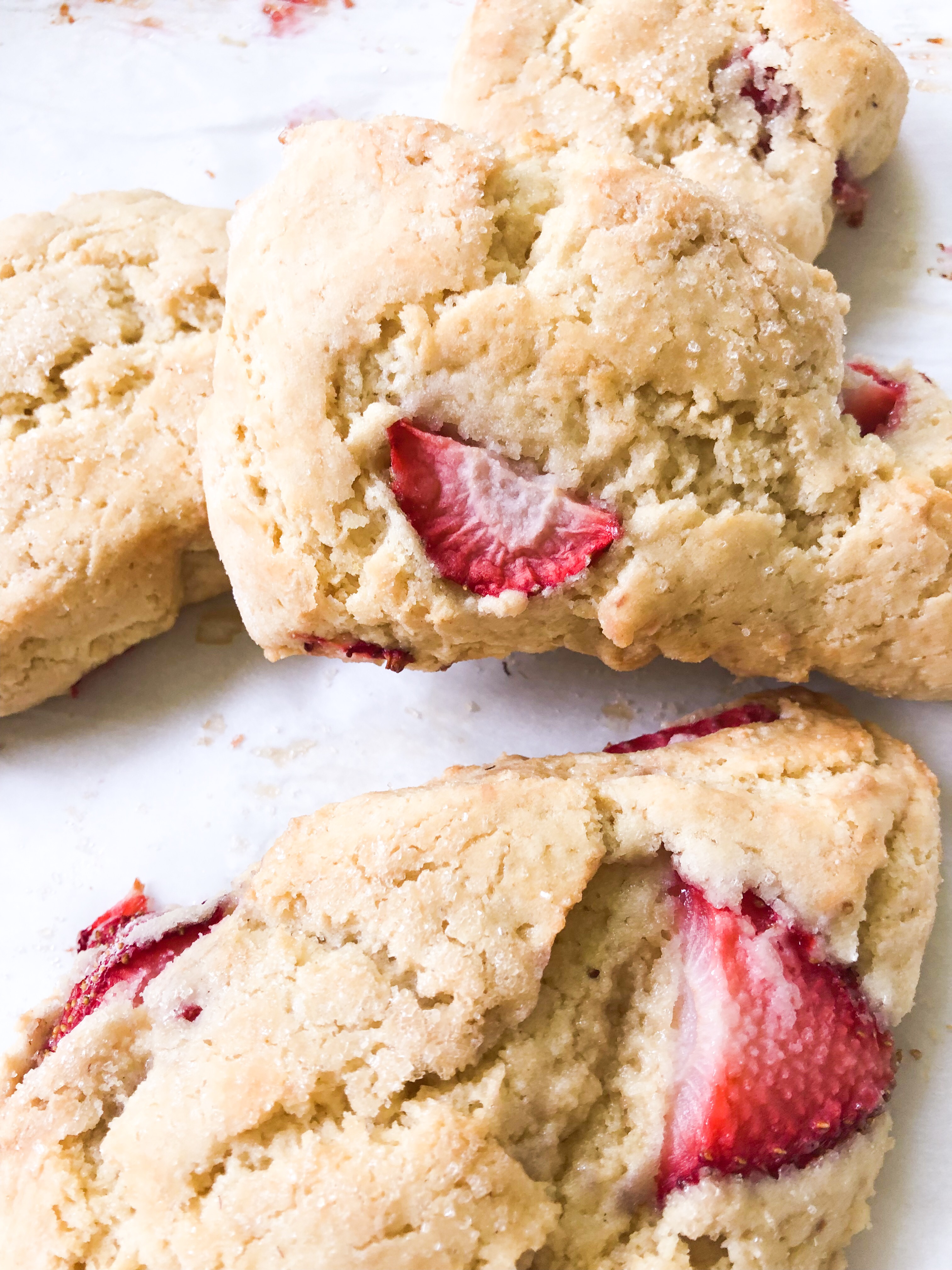
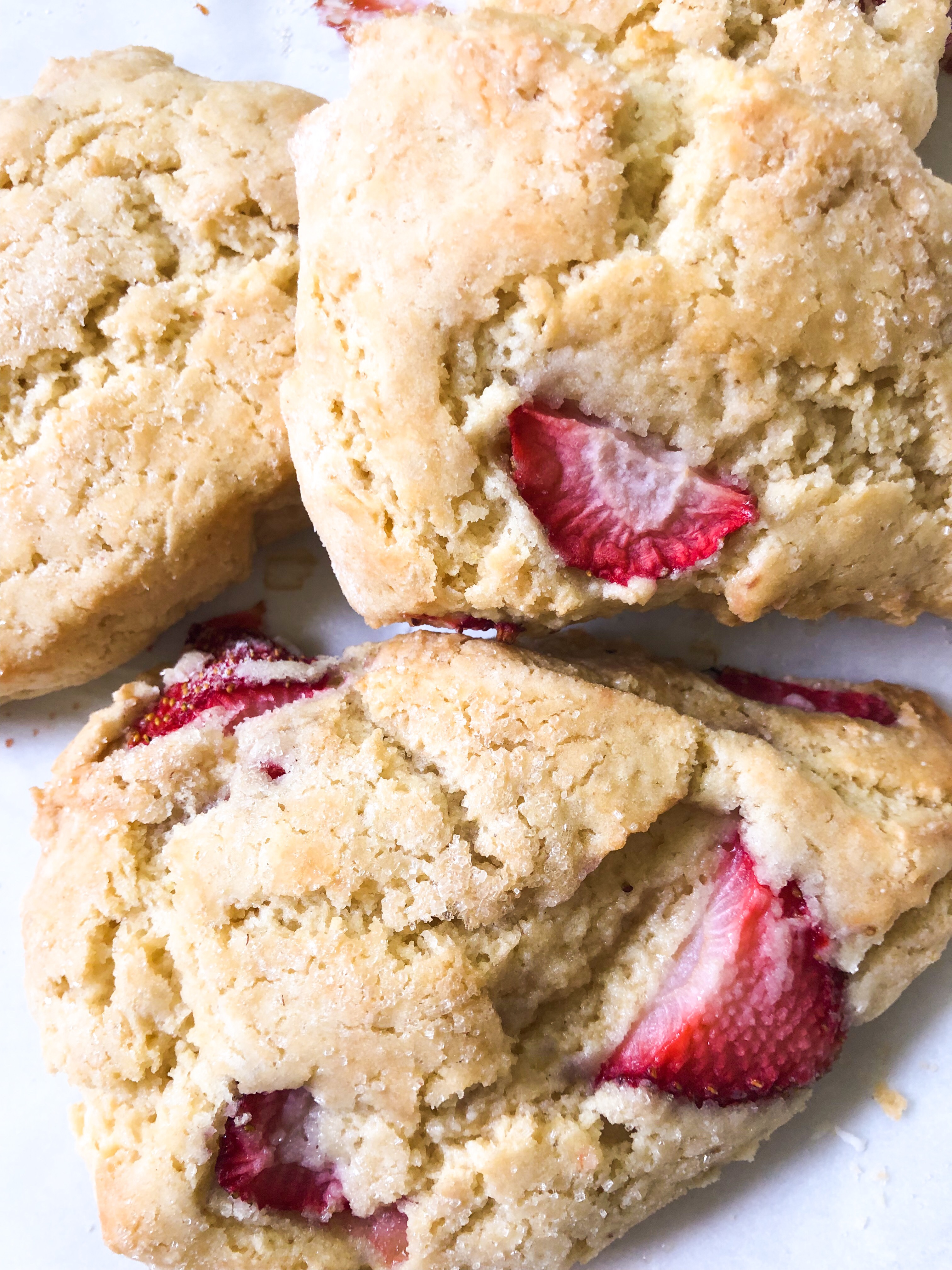
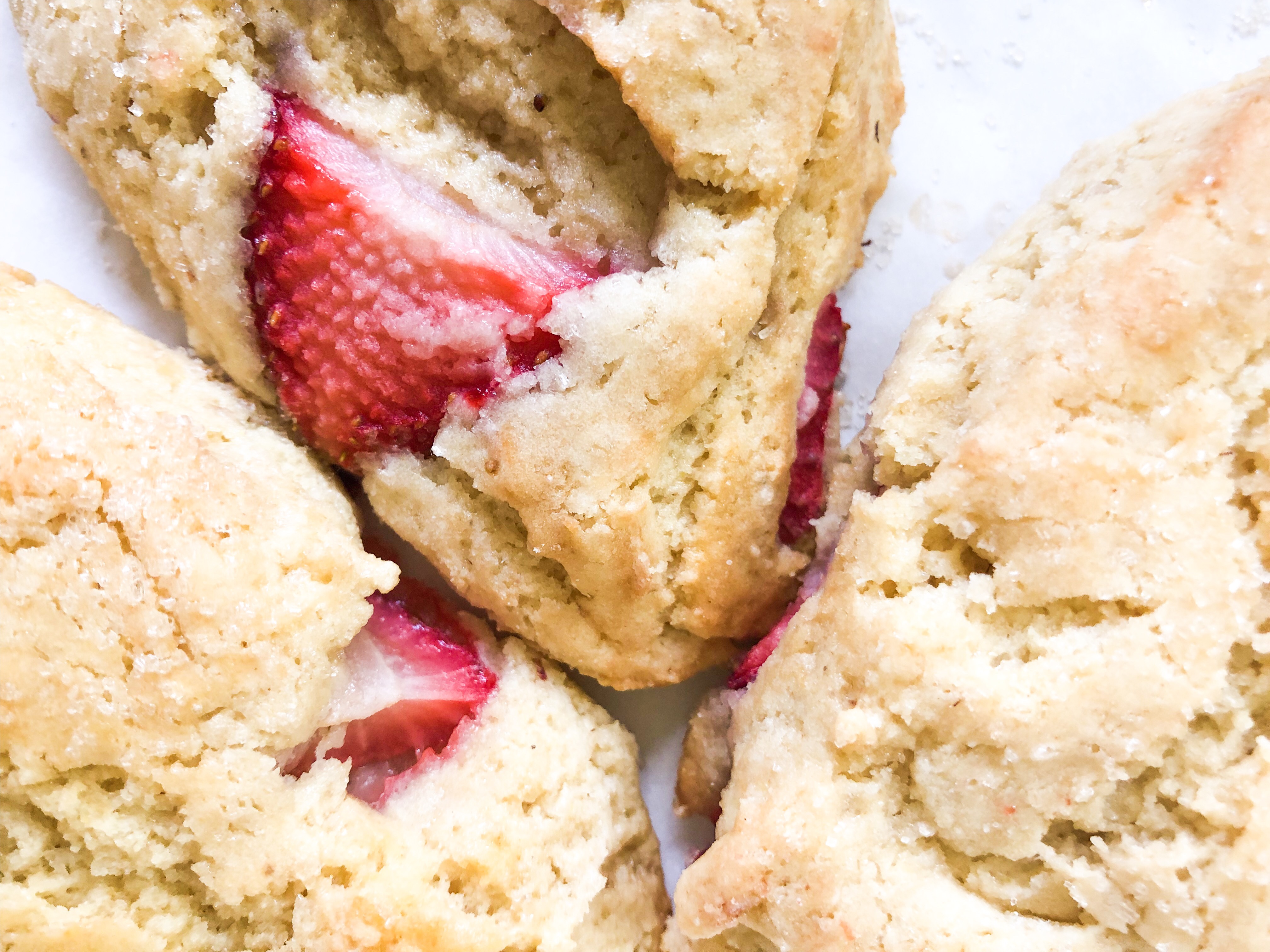
My mom came over this week for a belated Mother’s Day lunch and as I always do when anyone comes over, I wondered (worried about) what I should make. When planning a meal, I almost always think of dessert first because that’s the fun part. I hadn’t baked scones since last summer, and I had a few cups of organic strawberries in the fridge I needed to use up, so the scones definitely had to be strawberry. This is a recipe I’ve baked many times and it’s adapted from this recipeon the blog Sarah Bakes Gluten Free.
Strawberry Scones
1 3/4 cups gluten free flour blend, plus more for dusting the counter
1/2 cup sugar, plus more for sprinkling on top of scones
2 teaspoons baking powder
1/2 teaspoon baking soda
scant 1/2 teaspoon sea salt
5 Tablespoons of chilled Earth Balance soy free vegan butter, or another dairy free alternative such as palm shortening
1/2 cup unsweetened vanilla almond milk, plus more for tops of scones
1 teaspoon vanilla extract
1 cup sliced strawberries
Preheat oven to 400 degrees and line a baking pan with a Silpat or parchment paper.
In a large bowl, mix together the flour, sugar, baking powder, baking soda, and salt. Cut in the vegan butter with a pastry cutter until butter is pea-sized. Pour in the almond milk and vanilla extract and knead with hands until combined. Fold in the strawberries.
Turn out the dough onto a floured countertop. With floured hands, shape and flatten the dough into a 12 inch diameter circle. With a floured knife or pizza cutter, cut the dough into 8 wedges and place onto lined baking sheet. With fingertips or pastry brush, moisten the top of each scone with almond milk and then sprinkle sugar over the moistened tops.
Bake for 20-25 minutes or until golden brown. Allow to cool slightly and enjoy.
Note: To warm up a day old scone, place in a toaster oven for a few minutes. These freeze well.
Oh, and if you want to know what else I made for lunch when my mom came over: Shallot, Portobello, and Spinach Crustless Quiche (dairy-free) and a tossed salad with homemade vinaigrette. (Plus watermelon and cherries.)
For the past few weeks, I’ve had higher-than-usual anxiety levels. Lots of activity and a full house are definitely part of it, plus the changing weather, and my ongoing post-divorce inner work/healing. Yes, I know, we’ve all got stuff to deal with and we have to do the best we can every day. So, here is a list of some of the tools that are helping me get my anxiety under control each day.
Calming Aromatherapy Blend:
(4 drops Cypress, 3 drops Lavender, 5 drops Sweet Orange essential oil.) When my anxiety seems to be peaking, this blend helps me almost instantly. I put it in my diffuser, sit down to work at my desk, and within 10-15 minutes I feel that tightness in my chest ease, the inexplicable sadness and worry lifts, and I come back to myself.
I’ve said it before and will say it again: This blend of B vitamins and herbs really works to calm me down, boost my mood, and relieve stress. Whether for everyday anxiety issues or for situational anxiety, (before a performance, for example), it works for me within twenty minutes. You should have this in your natural first aid kit.
Walking outside for at least twenty minutes each day.
Just get out there! Your mood will lift, your ability to focus improve, your stress levels will drop, and your overall sense of well-being will rise. Feel the sun or rain or wind on your face, connect with your surroundings, and remind yourself that you are part of the planet, and the planet is part of you.
Meditation/Yoga/Prayer/Pranayama:
Pick one or do all of them, but whether you are praying, practicing yoga, meditating or doing breathing exercises like Pranayama, you will benefit with lowered stress levels and a calmer, more positive outlook. I enjoy meditating and practicing yoga with the YogaGlo app on my phone.
Watching something that makes you laugh.
I can get so serious and stuck in my head, trying to solve problems and get work done, that I forget to take a break and just laugh. Whether it’s I Love Lucy episodes, a movie like Beauty Shop with Queen Latifah or a TV show like The Marvelous Mrs Maisel, a good laugh session will do wonders for your mood and you’ll stress less.
Reading books on contemplative prayer and mindfulness:
Well, son, I’ll tell you: Life for me ain’t been no crystal stair. It’s had tacks in it, And splinters, And boards torn up, And places with no carpet on the floor— Bare. But all the time I’se been a-climbin’ on, And reachin’ landin’s, And turnin’ corners, And sometimes goin’ in the dark Where there ain’t been no light. So boy, don’t you turn back. Don’t you set down on the steps ’Cause you finds it’s kinder hard. Don’t you fall now— For I’se still goin’, honey, I’se still climbin’, And life for me ain’t been no crystal stair.
I sat cross-legged on my yoga mat one morning at the beginning of practice and began to cry. The instructor was guiding us toward the place we wanted to be and told us to focus on that, rather than the stuff in our heads, and the things that were wrong.
I was weighted by much that was wrong–real and imagined. Things I have continually heaped on myself since my divorce and things that I wanted to change about my own life and surroundings. Ways I attempted to control circumstances so I could bring order to places in my mind and body that I felt were lacking. I was a mess–full of anxiety and wrapped tightly into a cocoon of sadness and guilt and darkness.
On the mat, I began to moved through the poses. The focus was on strength and the idea was that we are stronger than we think we are. The poses became more intense. I shook in holding poses, (planks, especially) and felt fatigue hitting me in waves as I did yet another vinyasa. But as I continued through the difficulty of the practice I felt stronger and calmer and more assured that my life was a thing of complicated beauty.
Off the mat, several hours later, I began to meditate on empowering thoughts. Then I wrote them down. You know what? All that anxiety and guilt and regret and need to control my surroundings just melted away! It was such a relief!
This was so helpful to me that I wanted to share my list with you. I encourage you to make your own–it’s actually kind of fun and I think you’ll feel anxiety slip away and a sense of calm and strength center you.
I Can
I can be my best self today.
I can tell the truth today.
I can enjoy my life today.
I can be kind and generous to myself today.
I can be kind and generous to others today.
I can bring ideas and solutions to work today.
I can accomplish what I need to today.
I can listen today.
I can say I’m sorry today.
I can release the past today.
I can learn today.
I can be enough today.
I can matter to others today.
I can love people today.
I can take care of my body today.
I can take care of my soul today.
I can love my children today.
I can love my husband today.
I can stay in the light and not hide today.
I can be a good friend today.
I can drink enough water today.
I can get outside and let Nature embrace me today.




 Life of Kim