Engineering A Life (Book Reviews)

fullsizeoutput_ce8.jpeg

As you head off to work or to your home office this Monday morning, you may feel the need of some motivation. The following is a short book review of a highly inspirational true story. 

Krishan Bedi is someone I admire. He came, as a young man, to the Southern U.S. during the early 1960s with the purpose of obtaining a degree in engineering. He had little money, didn’t speak English very well, and had no experience with American culture or the American educational system.

In short, he took a huge risk to leave everything and everyone familiar behind and live an adventure. Because that’s what it was. He had a very courageous, impulsive and fun-loving spirit, which, I’m sure, helped him to face and overcome the numerous challenges that presented themselves. Sudden disaster, foolish decisions, and working menial jobs to earn enough to survive kept his life quite interesting in the early years.

But even finding a measure of success doesn’t mean that circumstances stay at an even keel the rest of one’s life. He faced hardship and unanticipated difficulties, but he kept going, kept trying, kept looking for the next step, for a better path. You will laugh at some of the hilarious situations he finds himself in, you will gasp at some of the unwise decisions he makes, you will share in his grief as he goes through loss and disaster, and you will cheer when he comes through it.

The book is called Engineering a Life: A Memoir by Krishan K. Bedi. I highly recommend this one. First, as a book to motivate and inspire you. Second, to see life through the eyes of another.

I received a copy of this book from NetGalley in exchange for my honest opinion and review.

Mystery and Poetry, Two Constant Companions

Since my seventh birthday, I have pretty much been addicted to mysteries. My mom’s friends, Pat and Judy, gave me a couple of Nancy Drew mysteries that year and my mind was opened to the scary, thrilling, who-done-it genre and I’ve never looked back. Sure, I’ve read some disappointing ones full of boring characters or convoluted plots that made me yawn, but, overall, I’ve found mysteries to be soothing and reassuring that no matter what is wrong in the world, by the end of the book, the odd little detective will have solved it and I can go to sleep confident that right triumphs.

I received Louise Penny’s latest book, Glass Houses, as a birthday gift this past year and I just finished it on Sunday. Her series is a little bit cozy, but only on the edges. It has all the depth of a novel, because she goes deep with her characters and most of them carry on from book to book. If you haven’t read her books yet, this is the year to give them a try. Three Pines is an imaginary village outside of Montreal, full of lovable, quirky people that you will want to read more about. No matter what evil they come up against, the townspeople live their unique lives and pull together when they’re needed. This story has to do with a hooded figure showing up in Three Pines, the drug trade in Montreal, and, of course, a murder. That’s all I’m saying. Read it for yourself and let me know what you think.

The other genre I’ve always kept close to me is poetry. I’ve got a poetry book or two going at all times…and so should you. Poetry is for everyone. If you don’t think so, maybe you need to keep looking. Mary Oliver, anyone? I just finished reading (again) Everything Is Waiting for You by David Whyte. Do you ever get days where life seems too much? Where emotions are overwhelming and tears break out for the smallest reason? Maybe it’s my Italian blood, or because I’m an HSP/ INFJ, or because I’ve been through lots of change in my life the past few years, but this happens often. On those days, I read poetry. Something elegant, simple and deep that speaks to the heart of sadness, the edge of elation, down to the bottom and all the way to the top of the emotional gamut. Thank you, David Whyte for breaking open your soul and writing down what spills out. I suggest you, dear reader, get one of his poetry collections and let it sink in. You need it, I’m telling you.

So, what are some of your favorite genres? What are you reading right now?

Educated, (Book Review)

When I started reading Educated: A Memoir, by Tara Westover, I was expecting a story about a homeschooler–an unschooled, perhaps. Within a few pages I realized my error; this was no homeschooling family she belonged to.

Tara was born into and raised in a very dysfunctional and dangerous environment within a large family ruled by fear of their mentally ill father. As she described her experiences out in the wilderness of Utah, her and other family members’ scrapes with death, how her father treated them, and how she perceived these experiences, I just shook my head. This was her normal.

She was indoctrinated to think anything else was “of the devil” or “worldly”, due to her father’s mix of Mormonism and mental illness. I kept wanting her mother to stand up to him, but she rarely did. I cheered when Tara finally escaped in her late teens to attend college, and couldn’t believe it each time she returned to her family home over and over again. Her education outside of her home life, over time, had enough of an effect that she came to view life, religion and the meaning of family differently, but I don’t know if any education could ever erase the effect of those deep roots of shame, guilt, neglect, abuse that she suffered.

I am thankful Tara was able to share her story with the world, that she could find enough courage within herself to walk away from everything she knew and start again. If you haven’t already, you will hear a lot about Educated this year. I suggest you pick up a copy and read it for yourself.

* I was given a free e-copy of this book by NetGalley in exchange for a fair and honest review. All opinions are completely my own.

Song of a Captive Bird (Book Review)

When I requested this book, Song of a Captive Bird, by Jasmin Darznik, from NetGalley, I knew I’d be in for a reading adventure. I know nothing about Iranian poets, past or present, and not much about Iranian history or culture. Because this was about a poet from Iran, Forugh Farrokhzad, who was also a woman drew me to it–that and the title. The book read a bit like a movie, opening with a mysterious and violent scene that became clear as the story continued and the cultural traditions and expectations were explained.

As it takes place in the fifties and sixties, in a land very far away and different from my own, there was much to be discovered about the way people lived and thought about life in general, and about women, in particular. Forugh suffered at the hands of men–her father, her husband, her lovers, and a male-dominated publishing industry. Her suffering marked her, but her resilience and independent spirit shaped her into who she became. Again and again she defies cultural expectations and pioneers a path for herself and women after her with the words she writes, her work in film, and the way she lives. The poetry that is woven into the chapters is exquisite; I savored the lines and felt closer to the woman whose story was being told.

In addition to learning a bit about Iranian women struggling to become respected and independent during that time period, I learned something of the struggle for Iranians to own their oil and of the violent political turmoil of those days. To me, Forugh is a symbol of progress, of the artistic voice that speaks in every culture and time period, and of every woman working toward being respected and heard with equality.

Reading this book stirred up a desire to read Iranian poetry, of which I am unfamiliar. If you’re like me and know little to nothing about Iranian history and culture, and particularly, Iranian poetry, then I recommend you read this story and start your own journey of discovery.

*I received a free copy of this book from NetGalley in exchange for a fair and honest review.


Everything Happens For A Reason (Book Review)

I just finished reading Kate Bowler’s Everything Happens for a Reason: And Other Lies I’ve Loved, a memoir of her life before and with incurable Stage IV colon cancer. If you’re like me and tend to shy away from books about terminal illness, you might think it will be a dark, depressing, hopeless tale that will leave you in tears and in a blue mood for a week.

This book isn’t like that. Kate is smart, funny, and endearingly honest with how she faces this illness day by day. She has a young son and a husband whom she loves and doesn’t want to leave. There is no way to ignore her sense of grief as she lives with the fact she is dying, but she is no Debbie Downer. Her narrative goes along with her emotions and thoughts in a way that is tender and raw and completely relatable. She feels sadness, anger, and despair, but also joy, gratitude and hope.

Throughout, she expresses her thoughts on Christianity, particularly the prosperity message and how it does not serve people who face terminal illness or catastrophic events of any kind. By relating not only her experience, but those of many others who have gone through the loss of loved ones or who are ill themselves, she shows how this message does a lot more harm than good. Although she remains a believer, how she thinks about God and Divine interaction does go through an evolution as she attempts to make sense of her circumstances.

What stands out to me, aside from the fact that the book is interlaced with references to the Christian prosperity gospel, which I am very familiar with, is how well she brings the reader so close to herself and her story. You will feel like a trusted friend who is allowed to hear her unedited version of what it’s really like to be her as she makes this journey. Kate Bowler has given the world a gift with this book. I walked away thankful for even the tough things in my life and with a determination to not waste a moment of it. I highly recommend that you read this book for yourself.

* I received a free copy of this book from NetGalley in exchange for an honest review.

Shortie Book Review

EAC65091-BC75-4E2B-9185-690F77499DD1

I went out on a limb and read a book outside my comfort zone: Everything I Never Told You by Celeste Ng. The reason it’s not the type of fiction I would usually pick up is that the story starts with a child’s death. Although I haven’t yet taken Anne Bogel’s reader personality quiz, I have a feeling I read fiction to escape. And hopefully to escape into a world that differs from my own–adventure, danger, foreign countries, suspense, bravery, etc.

This book began with the worst thing any parent could imagine: experiencing the death of a child, so I expected if it started from an extremely low point, it had to get better. To her credit, Ng writes in a graceful, fluid style that is easy to read and soothing to a lover of words. The story is basically about one family’s dysfunction and the heart-heavy path each one takes as they find a way to keep on living after their daughter and sister’s death. I didn’t really relish being the observer of their grief process. I never enjoy sad books, especially if they’re fiction, because I become too emotionally involved in their fictional lives. It takes a toll on me and I feel like everyday life does that already.

Anyway, if you like sad stories with a glimmer of hope at the end, this one might be for you. If you aren’t great at handling dark and oppressive family dramas, then skip this one.

One Book I Hate

eb574e14-bd79-4b72-a254-3a484540127d.jpeg

Oh, I’m not one to shy away from saying I hate a book if I do. It’s true that some of the people interviewed on Anne Bogel’s podcast What Should I Read Next say they don’t like to actually admit that they “hate” a book. Whatever.

I tend to have strong reactions to books, especially if I’ve invested many nights reading diligently through them, trying to be patient as I wait for a part worth reading. The chapters plod on, but no dice. I get to the middle and nothing improves, I realize it’s a lost cause. Most of the time, in recent years, I’ve abandoned the book, like a pair of jeans or shoes that just never fit right. Just not for me or at least not right now.

In the case of 11/22/63, however, I kept going. Why? Because it’s Stephen King we’re talking about. He is a master of writing, or at least so I’ve heard. Before this book, I’d only heard others discussing his work, but never had read anything of his for myself. What made me start now? I’m definitely not a horror fan, but know plenty of people who are. This book, as it turns out, is not in the horror genre, but is touted as a time-travel mystery/thriller. I am a reader of mysteries, plus I’d heard plenty of positive reviews and comments about this book, so I had to read it. This past spring, when Alan and I were at a used bookstore, I purchased a copy, and it sat all summer waiting to be read. Alan is in the middle of King’s Dark Tower series, so I thought I’d jump on the bandwagon and read one of his books too. What a mistake!

The book is told from the perspective of a thirty-something high school English teacher who is divorced and doesn’t have anything interesting happening in his life. He gets tangled in a time-travel adventure which involves going back to the late 1950s and attempting to save JFK from assassination. It starts off in Derry, Maine, where “It” lurks, apparently. Since the assassination takes place in Dallas, the protagonist has to relocate there and live until ’63.

All I can say is it drags on and on. Lee Harvey Oswald and his family live in a poor neighborhood. He is abusive, fanatical and downright boring. Day after boring day we get play-by-plays of what he and his wife say or do, who comes to his house, etc. I can’t tell you how I kept looking for something interesting to happen. Yes, there is a romance that brews and a couple of violent and action-filled scenes to shake things up. So I hoped things would improve.

After 850-plus pages, though, the book ends in sadness and futility. Oh my goodness. I felt so angry! What a waste of all those nights reading when I could’ve been reading something else. Although I will give King another chance and read his book entitled On Writing.  And I won’t recommend 11/22/63 to anyone.


Have you read 11/22/63? What did you think?

My Book Stack


IMG_1936

I could talk about the books I’m reading every day, and I usually sneak it into the conversation somehow.  Happy November 1st! For those of you participating in NaNoWriMo for the first time ever, you may be wondering, “What on earth have I gotten myself into?” or perhaps you’re like me and scared but excited. Remember Seth Godin‘s question on the front of Poke the Box: “When was the last time you did something for the first time?” Well, when was it? This is a great opportunity. Let’s do this!

If you’re not participating in NaNoWriMo, you’re probably more sane than I, but hopefully you still love books and the reading life. I attempt to keep my Goodreads profile up-to-date, but I add, discard and finish books so frequently that it sometimes lags behind. Right now, it’s fairly current, give or take a few.

Here is the list of books I’ve been reading for a few days, months or a year:

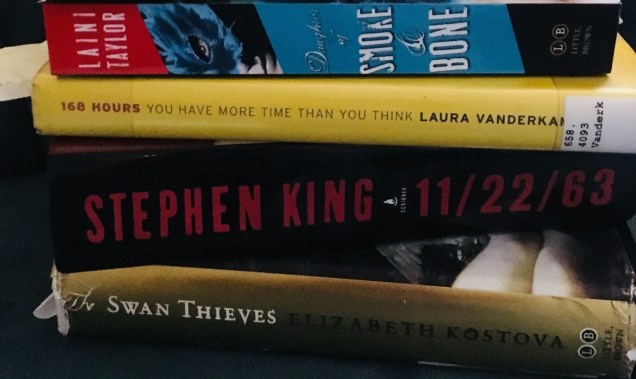
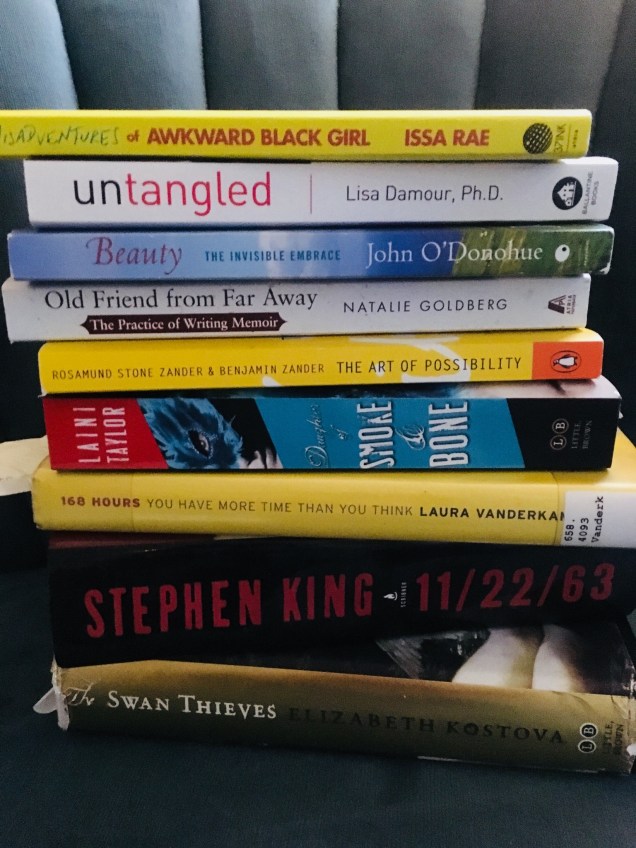
168 Hours by Laura Vanderkam. I mentioned this in Monday’s post. We do have time–all the time we need to work, sleep, spend time with loved ones, do chores and errands, exercise and do the things we dream of doing.

Untangled by Lisa Damour. I heard of this on ModernMrsDarcy. If you have a teen daughter, if you’re confused or hurt by her behavior, you should read this. Lisa explains why and will take you through the seven stages of adolescence.

11/22/63 by Stephen King. A high school English teacher is asked to go back to 1958 and save JFK and a few other people as well. As are all King’s books, this one is gigantic, but I believe it’s going to be worth it.

Daughter of Smoke & Bone  by Laini Taylor is YA fantasy, about a blue-haired girl with super-powers and a dark past, so I’ve strayed from my usual picks. It’s interesting so far, I just need to discipline myself to dig in deeper.


The Misadventures of Awkward Black Girl by Issa Rae. Recommended on Modern Mrs Darcy, I picked it up and two minutes in I was laughing.

The Swan Thieves: A Novel by Elizabeth Kostova is very well written, but the story is slow and sad. Lots of unhappy domestic emotions. I’m hoping it ends up in a different place.

Old Friend from Far Away: The Practice of Writing Memoir by Natalie Goldberg is a book for writers, filled with prompts. I need to faithfully do two or three a day, but I hate rushing through her books. I want them to last forever. Her voice and realness combined with a generous dose of humor comfort me and help me when I’m struggling to push through self-doubt or procrastination.

Beauty: The Invisible Embrace by John O’Donahue. I’ve been savoring this book for a year. With two chapters to go, I’m telling myself it’s time to finish it. I can re-read it later.

What are you reading lately?

EB574E14-BD79-4B72-A254-3A484540127D


Day 30: Find Your Gumption Button

IMG_1480

Did this Monday find you with its cold, windy, cloudy song? I got up later than I wanted to because it was darker than I expected. Then, the sound of the recycling truck whizzing by and honking made me bolt up from slumber, remembering that we forgot to take the recycling bins to the road last night. Sigh. I had such good intentions before I fell asleep last night, too. I planned to wake early, go to the gym, and be at my desk by 9. There’s a little thing called an alarm on my phone that I forgot to set though, so that’s the story.

What I do with the rest of my day will be where the real tale lies.

Last Friday, while eating lunch, Alan and I talked about motivation and how some of us have more than others. People like Seth Godin seem to never run low, but perhaps it’s because he practices daily; he is self-disciplined and drives himself to produce and ship. Whether he feels ready or not. That’s one of Seth’s messages.

There are high-profile people in the music, visual art and writing fields that we know or know of who continually produce and ship. They are on Instagram multiple times per day showing us their quality work. We admire them. We wonder what their secrets are.

As far as I can tell, though, it’s up to each person to find their gumption button, to pull up their boot straps and get to work. You can only talk and think about it for so long and then you need to just do the work.

We have all kinds of excuses–not good enough, lots of people do it better, I’m not creative enough, no one will read, see or hear it–and what you mean is, you’re afraid. That’s ok. We are all afraid. But we have to tell Fear where to sit, as Elizabeth Gilbert says. Fear can’t be in the front of the room or in the driver’s seat. Fear can take a back seat or sit in the corner. You can recognize it and acknowledge it, but you are in charge. You. And nothing is stopping you. Not really.

Here are three yellow books I am reading that are kicking me in the pants, feeding me knowledge, and showing me there is another way of seeing. If you need encouragement to get your priorities back where you want them,  to do work you’ll be proud of, read these books.

Poke the Box: When Was the Last Time You Did Something for the First Time? by Seth Godin. I read this one before, but am reading it again. Short blurbs or passages with on-point messages are presented in Seth’s one-of-a-kind style. You can’t help but wake up and realize your goals are within reach and the time is now. Here’s an excerpt from pages 24-25,

“The relentless brainwashing of our fading industrial economy has created an expensive misunderstanding. Creative people or those with something to say believe that they have to wait to be chosen…’pick me, pick me’ acknowledges the power of the system and passes responsibility to someone else to initiate. Even better, ‘pick me, pick me’ moves the blame from you to them. If you don’t get picked it’s their fault not yours. If you do get picked, well, they said you were good, right? Not your fault anymore. Reject the tyranny of picked. Pick yourself.”

168 Hours: You Have More Time Than You Think by Laura Vanderkam. I heard about this author and this book on Modern Mrs Darcy. Since I was actually at the library in Ithaca yesterday, I grabbed this and one of her other books. In the introduction and first two chapters, she destroys the common belief that the modern person tells themselves: we don’t have enough time. We do, she insists, and she has science and our own schedules to prove us wrong. What an uplifting and life-giving idea. We can do what we want to do, what we dream of doing. We have all the time we need.

The Art of Possibility: Transforming Professional and Personal Life by Rosamund Stone Zander and Benjamin Zander. I’m only in the third chapter of this one, but can tell it’s going to rock me. This was one of Todd Henry’s recommended reads at the beginning of 2017. They bring up the concept of scarcity-thinking and talk about how it’s shaped our culture to think in terms of limited resources, shrinking reserves and other people as competitors. And how the world of measurement has framed our thinking. Then they use the terms “generative” and “the universe of possibility” and ask us to step outside of those frameworks and consider that anything is possible.


 

IMG_1337

Day 29: Soul Sustenance

IMG_1477

I haven’t been “to church” in over a year. Long story, but after my whole life, I needed a break.* Sunday mornings are no longer a mad dash to arrive on time. I get up when I feel rested. Eat gluten free pancakes or French toast with Alan and the boys, go to the gym, plan my menu, make a new “weekly” page in my bullet journal, write, read, and work on projects. Occasionally, I feel heaps of guilt for not being involved and serving the way I was raised to. There was a security in doing the same thing each Sunday, to knowing I was serving God and the church community, and in receiving approval from the circle I was in.

After major life changes in the past two years, including leaving the church I was involved in and getting a divorce, I’ve been finding new ways to relate to God and think about spiritual matters. This can make me feel unsure of myself as a spiritual person, as a believer, as I explore outside of the familiar framework I’ve leaned on since childhood. Will I return to a local expression of faith some day? Perhaps I will. I like to think I will.

For now, I’m looking for God everywhere I am, as I always have. I am retaining my relationships with friends who believe. We share thoughts and ideas, holding real and honest conversations about church and faith. After leaving the community I came from and spending this past year asking myself what I believe and what do I identify with, I sense a close connection with Celtic Spirituality or Celtic Christianity. 

What mattered to the ancient Celtic believers resonates with me: having a hope-filled outlook, caring for our environment, appreciating art and music and using them as an expression of worship, being hospitable and open to change, etc. Like the Celtic Christians, I use imagination as a way to connect to and understand the divine. Although these characteristics can be found in other faiths and indeed, in other forms of Christianity, this is where I feel most at home. It’s interesting, because as a young adult of eighteen or nineteen, I felt drawn to this way, and here I am again. As T.S. Eliot said,

“We shall not cease from exploration, and the end of all our exploring will be to arrive where we started and know the place for the first time.”

As I always have, I enjoy finding resources to enrich and develop my spiritual understanding.

Here is one tool I use to dig deep: it employs the practice of a weekly and one yearly examen, or reflection of my days in these seven areas: spirit, mind, body, work, home, relationships, and resource stewardship. There is also a moving forward or “reset” for the week ahead. Included is spaced to develop something called a “Rule of Life” that one can develop as a way to be intentional about personal priorities for daily living. Check it out:

Sacred Ordinary Days Liturgical Planner

The next three books enrich my spiritual journey. Maybe they would do the same for you.

To Bless the Space Between Us: A Book of Blessings by John O’Donahue would make a lovely gift to another or oneself. I received my copy as a gift. The contents are grouped by “Beginnings”, “Desires”, “Thresholds”, “Homecomings”, “States of Heart”, “Callings”, and “Beyond Endings”. No one wrote quite like him. The grace and musicality of his words, poetry or prose, speak and reach into the dark and confused places, as well as the light and clear ones. Here is an excerpt from the poem “For The Interim Time

You cannot lay claim to anything:                                                                                                    In this place of dusk,                                                                                                                         Your eyes are blurred;                                                                                                                     And there is no mirror.

Everyone else has lost sight of your heart                                                                                  And you can see nowhere to put your trust;                                                                              You know you have to make your own way through.

As far as you can, hold your confidence.                                                                                      Do not allow your confusion to squander                                                                                   This call which is loosening                                                                                                            Your roots in false ground,                                                                                                                That you might come free                                                                                                                From all you have outgrown.

What is being transfigured here is your mind,                                                                            And it is more difficult and slow to become new.                                                                     The more faithfully you can endure here,                                                                                  The more refined your heart can become                                                                                       For your arrival in the new dawn.

The Artist’s Rule: Nurturing Your Creative Soul with Monastic Wisdom by Christine Valters Paintner. I’ve only just begun reading and savoring the content in this book, exploring the practices and engaging in the artistic reflections. Week Three, for example, “Sacred Tools and Sacred Spaces“, discusses the sacraments of daily life, the sacred art of living and then engages the reader with contemplative practices–lectio divina, reflection questions, visual art exploration, and poetry exploration. It’s deep, but has fun hands-on ways to explore and express.

The Inner Voice of Love: A Journey Through Anguish to Freedom by Henri Nouwen, I’ve already mentioned this week, but here it is again. This was his personal journal from a very dark, anxious and fearful season in his life–his journey through. A friend of mine gave it to me at the start of a dark, fearful season of my own.

So here is a glimpse into my own story of faith. I’d love to hear from you–what’s encouraging you today?

(Disclaimer: I’m not encouraging anyone to leave their church or local expression of faith. There is plenty of life, growth, encouragement and goodness to be found in thriving faith communities the world over. If you have found such a place, I hope you can stay, call it home and become one of the family.)

DSCN5007