For those of us who observe the Christian liturgical year, we have come to the end of Lent, and are now in the Easter season. Lent always feels long and this year even more so with what is happening here in the US and around the world.
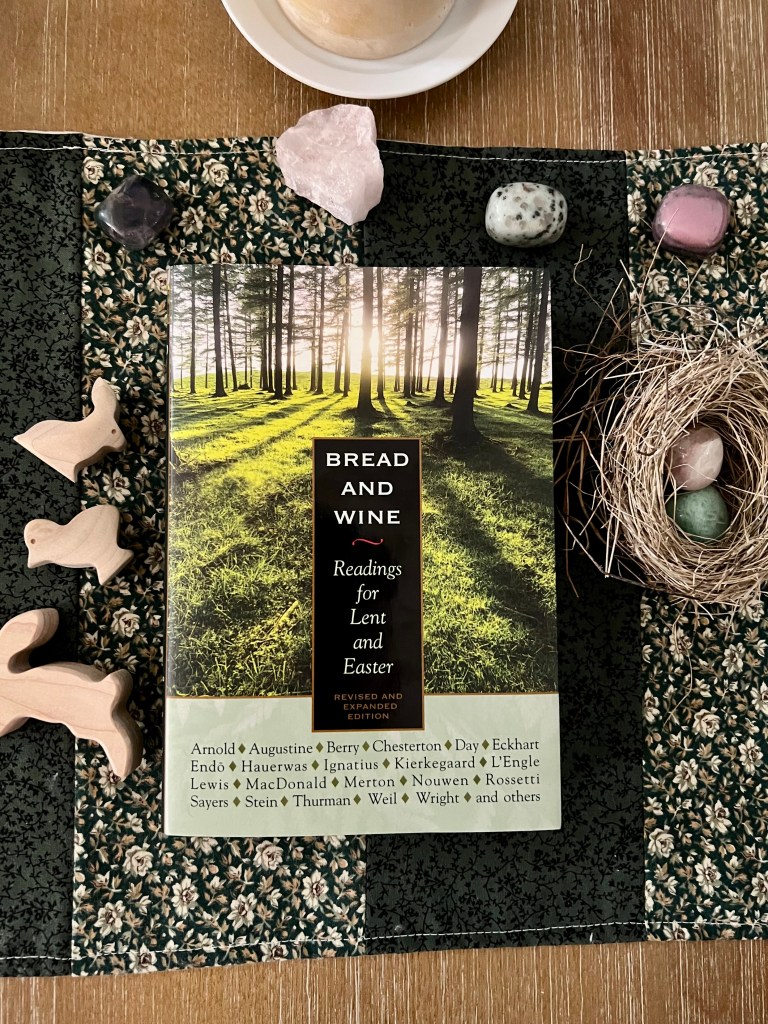
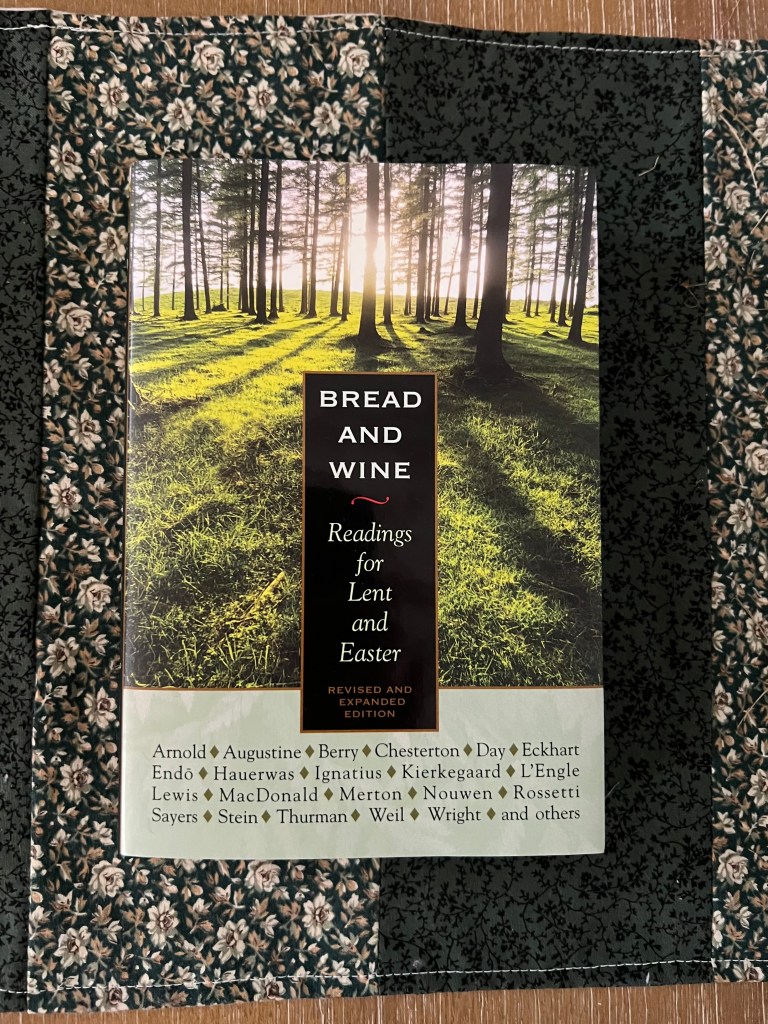
When I am feeling the cold and bleakness of Lent, or when I am feeling anxious and fearful, I am always thankful for the words of wise people who have gone before me. And this is why Bread and Wine: Readings for Lent and Easter, is a book I’ve kept close by throughout the Lenten and Easter seasons for many years. When my own faith wavers or my spiritual fire gets low, I can be inspired and uplifted by the insights and experiences of others, which fan the flame of my own spiritual hunger, and help me to keep walking.
Within these pages, I read (and re-read each year) passages from Barbara Brown Taylor, Wendell Berry, Amy Carmichael, Karl Barth, Thomas Merton, Henri Nouwen, Dorothy Day, and Dorothy Sayers, plus many more.
And I’ve been encouraged by these readings, such as by these words from Kahlil Gibran in the chapter entitled “The Crucified”:
“Jesus was not sent here to teach the people to build magnificent churches and temples amidst the cold wretched huts and dismal hovels. He came to make the human heart a temple, the soul an altar, and the mind a priest.”
Or from the chapter entitled “Not All Right” from Tish Harrison Warren:
“The ones Jesus calls are the weary ones, the ones who snap at those they love after a long day, the ones who battle addiction, the ones who aren’t who they wish they were, the ones who know they are not strong, the ones who wrestle and repent, who fail and fail again. This is the church, these ones through whom Jesus is strong.”
Or “Waiting With Mary” by Kathleen Mulhern which both honors Mary’s experience as mother and disciple of Christ and helps us imagine what it must have been like for her as he was crucified, buried, and resurrected.
If Lent is a season you observe, Bread and Wine may also become for you a companion to take you through the reflective season of repentance, fasting, and prayer to the celebration of Easter and beyond, all the way to Pentecost. Find Bread and Wine: Readings for Lent and Easter at your local bookstore, online at Bookshop.org and Amazon.
Once again, the time has flown by and it is almost three months since I posted here. Partly it’s because I’m writing so frequently on Substack, and partly it’s that the holidays took more time than I anticipated, no matter how much I tried to have a slower season. But I’ve been planning posts for you here as well and now that we’re into a new year, it was time to write and catch up with you.
I enjoyed a slow start to January, and needed about ten days after Christmas to catch up on sleep and calm myself down after weeks of activity and lots of stimulation. Do any of you feel this way after winter holidays?
Yet I also have this excitement about a new year beginning, even though I know we really can start something new or start over any time of year. I love to write down goals and plan out how to make them happen. And I like the discipline of a routine after a few weeks in limbo during late November and December. Below is a list of what I’ve been doing or thinking about, and what I’m planning in the next few months.
Re-committing to a Routine: This year, I plan to meditate and practice yoga every morning. And to work out and/or walk every day as well. I feel the need to be as strong, grounded, and healthy as I can be for whatever this year brings. And journaling every day is also one of my commitments.
Journals and Planners: Starting new journals and planners is such a joy each January. I’ve got several going for different reasons or needs. I recently shared a post about journaling on Substack, which you can read here (and do subscribe!).
The Cycles Journal is to track my cycle, physical and emotional symptoms, moods, wellness routines, etc. This is my fourth year using this journal and I wish I’d had it in my twenties and thirties. I gifted one to my daughter and another to my niece in hopes that they’ll connect more deeply with themselves and their cycles this year.
Molly Remer’s Prayerbooks on Lulu are what I use to write down spiritual things specifically such as prayers and poems, thoughts and questions.
Woodspell Apothecary’s Planner is beautiful, spiral-bound, and connects me to the land, the moon and herbal medicine. It’s my third year using this planner and I love it more than ever.
The Bullet Journal is where I write daily lists, goals for the month and year, and record other things such as favorites lists.
We’Moon Planner is feminist datebook with artwork and there are poems and short pieces throughout that are read from during Molly Remer’s monthly circles.
Leonie Dawson’s 2025 My Brilliant Year Workbook: Biz Edition is a good way to reflect on what worked and what didn’t in my business last year and how I want to do things differently this year.
The Life Organizer by Jennifer Louden isn’t a journal, rather she offers weekly questions that are very helpful for women, especially busy mid-life women, to discover what they really need and how to make themselves a priority in the middle of it all.
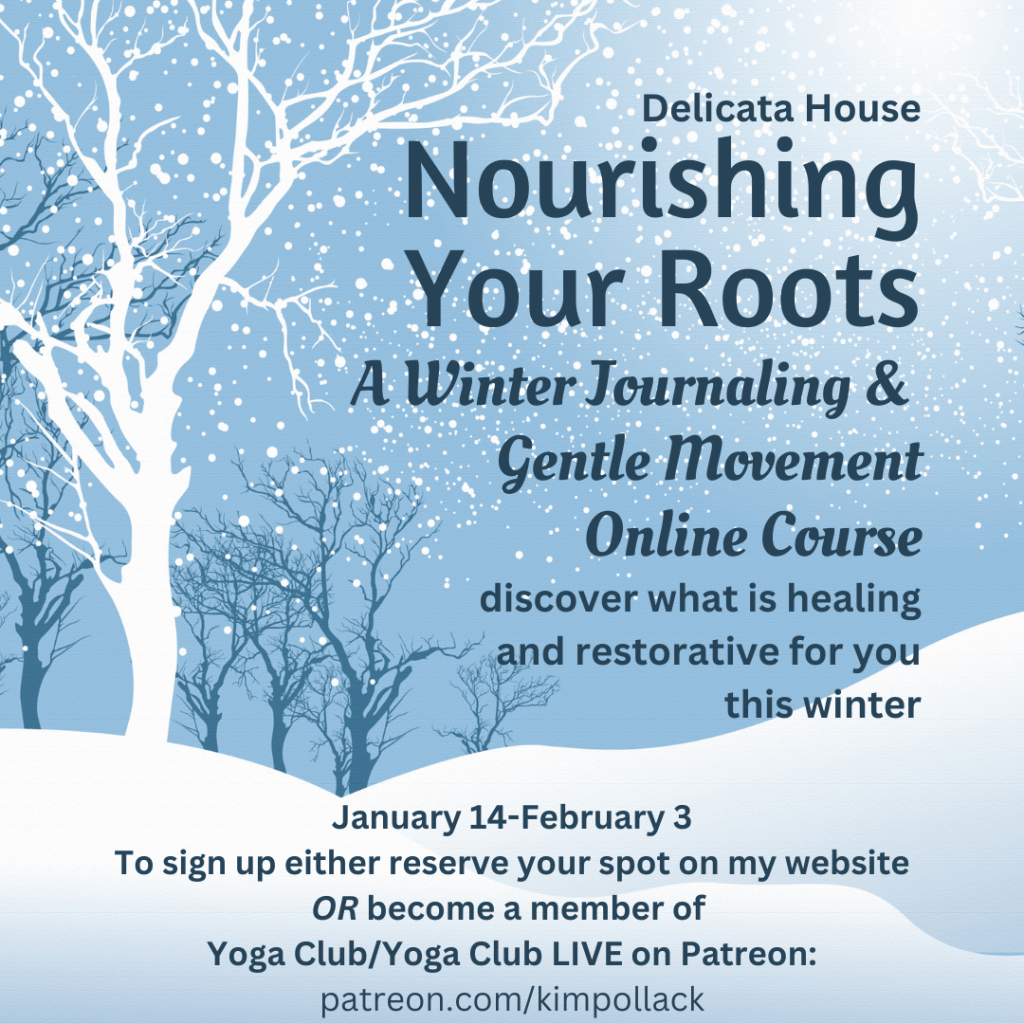
Journaling & Gentle Movement Course: I’m offering an online course called Nourishing Your Roots: discover what is healing and restorative for you this winter. It starts January 14 and goes through February 3rd. I hear so many people say they’re stressed, tired, sick, unmotivated, and don’t seem to have clarity about their lives and goals. Journaling is one way to get focused and clear on what you really need and want in order to heal and have a more nourishing life. And movement helps us connect with our bodies, supports our immune systems, and lifts our mood. If you’re a paid member of either my Patreon or Substack, this course is free to you. Or you can sign up on my website, here.
A few of the books I’m reading this month (because there are always more):
This is Happiness by Niall Williams. I read Time of the Child just as Christmas was arriving and had to go back and read This is Happiness. So Irish, so full of characters that have a lot of life in them, such good stories.
The Art of Possibility by Benjamin Zander and Rosamund Stone Zander. I’m reading this one for my Substack’s Book Club. You can subscribe here.
Anne’s House of Dreams by L.M. Montgomery–I started reading through the series again in the late Autumn for comfort and to escape the harshness of the world scene.
When God Was a Woman by Merlin Stone–all about the history of the suppression and destruction of the goddess religions worldwide. For someone who grew up in Christianity, there is a lot I never knew about the damage connected to even the roots of our faith. It is a lot to take in, but I’m glad to know what history tells us.
And I hope to start The Scent of Water by Elizabeth Goudge. This is one of the books I received as a gift for Christmas and one of my friend Laurie’s favorite novels. I’ve been meaning to read it for years! Let’s see how I do with all of these this month.
How to format a book for self-publishing to Kindle or Lulu.
Projects I’m working on:
I want to make a few new scrunchies. One of my favorites broke the other day and I looked at it and thought, “How hard can this be?”
I’m putting together a few new sets for my shop: a Winter Skin Care Box, an Imbolc/Brigid’s Day Box, and a Valentine’s Day Box.
I’m brainstorming new courses to teach for Late Winter & Spring which may include yoga, Ayurveda, herbs, aromatherapy, journaling, and/or meditation.
What about you? What journals, planners or workbooks are you using this year? What are you learning or what projects are you working on? What are you reading this month? Please do share!
This morning I awoke to another day, with muted birdsong, and an orange sun rising over the trees at the end of the field across the street. My goal is to get up just before the sun and stand on the front porch or walk around for a few minutes to be present at sunrise. This is supposed to support a healthy circadian rhythm as well as give my eyes some much-needed red light therapy. My eye doctor said sunrise and sunset are good for reducing inflammation and bringing some healing to my dysfunctional dry eyes. (I don’t stare at the sun, I just face in its direction.)
It is cool this morning, and fairly quiet. The starlings left last week, I think. They were congregating all over the trees and lawn in front of the house one afternoon, making a racket, and then they were gone. They’re easy to notice because they’re so obnoxious, but other quieter birds have probably left as well and I’m not even aware of it yet. I haven’t seen a robin recently, but it seems too early for them to have left.
Since late August, it feels as if everything is waiting for Autumn to come. We’re still in that in-between place of what is now and what is not yet. I try not to be impatient for cool, crisp weather and the bright reds, yellows and oranges of leaves. The landscape seems to have faded into a yellow-green, and it’s dry. Not drought-dry, just dry. We haven’t had rain in a week and a half.
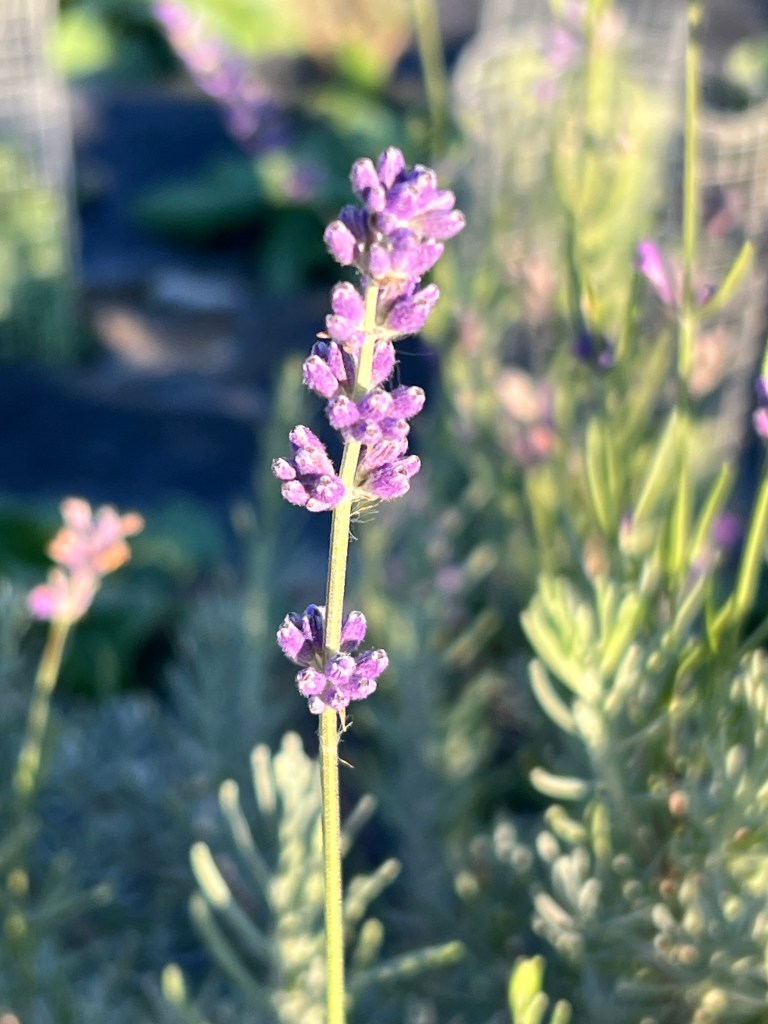
The Calendula and Bachelor’s Buttons are not putting out as many blooms, but the Asters and Dahlias are going strong and the Lavender Munstead/English Lavender bushes are blooming for the second time this season. This is the Lavender I love the most. It blooms in June, I cut it back after that, and then it blooms again till frost. I’ve been able to collect and dry many bunches, while still leaving plenty for the bees.
I walk around the garden, saying good morning to the plants, shaded by the row of White Pines in the backyard. I gather some parsley for my morning juice (currently celery, carrots, apples, ginger, lemon & parsley) and head back inside.
After a few minutes of yoga stretches and breakfast, I go outside with a basketful of new aromatherapy blends and crystals for my shop, plus my phone and a table for a product photo shoot. I collect a few flowers (yellow and gold Calendula, Feverfew, Lavender & Bachelor’s Buttons) from the garden as props to pretty up the photos and then spend an hour taking photos. This isn’t one of the favorite parts of my business. Editing I don’t mind, but the actual photography always makes my lower back hurt. I have to crouch or bend in an awkward way to take photos so an hour at a time is the max I’ll do. Right now I’m working through my product catalog, changing the background of things I keep in stock and taking photos of new products. I take photos, plus short videos of me holding each crystal so people know how big they are.
After a workout and a shower, I eat lunch and go upstairs for a nap. I don’t nap every day, but more often than not, I take a short nap and read for a while in the afternoon. On days that I’m tired and try to power through, I am so unproductive. I can’t think straight and make clumsy mistakes in whatever I’m working on.
This isn’t a day I can actually nap though, because the farmer who rents the field that surrounds us on three sides has sent what seems like every piece of machinery he owns through the field today. There’s more equipment out there again now. It looks like a disc harrow. Yesterday, a tractor with a spreader came through and it seemed he was dispersing pellets of some kind–fertilizer possibly? Then today, there was a plow, a seed spreader or maybe more fertilizer, a machine that sprayed something (hopefully water and not pesticide on a bare field), and then a couple of other machines that I lost track of.
So I work on a couple of Substack posts, and don’t finish either one. I start one about daily rhythms and another about a sense of place, in a similar vein to what I’m writing about here, and then drift off, uncertain how to wrap them up. I start a post about books I’m reading and then head over here to show up on this dear blog I’ve been neglecting for months!
When I think about this sleepy part of the world I live in, I have to laugh at how annoyed I get at all the farm machinery. Honestly, this is the most noise we ever hear up on this hill, during planting and harvesting. And it doesn’t last long. No construction noise, except occasionally in the distance, like a half mile or more away. Even the grain bin fan down at the end of our road is noisy only a few days a year. We have trucks and cars and school buses that go by, but nothing like on a main road. I live in Paradise compared to so many, and I acknowledge my privilege and am thoroughly grateful.
As that last piece of farm equipment chugs and whines away down the road, I listen and watch for the birds to come out of hiding and look for our herd of cats (six!) to come to the back door in demand of their dinner. The sound of crickets and the breeze tickling the leaves of the maple outside my window are all I can hear.
Tonight is the Harvest Full Moon. And the Equinox is only days away. As the Moon rises high over the fields and trees, I’ll give thanks for the many blessings in my life, and will offer a prayer for peace and wellbeing for all.
This post contains Amazon affiliate links. If you click through and make a purchase, I will receive a small commission at no extra cost to you. This helps keep my blog ad-free.
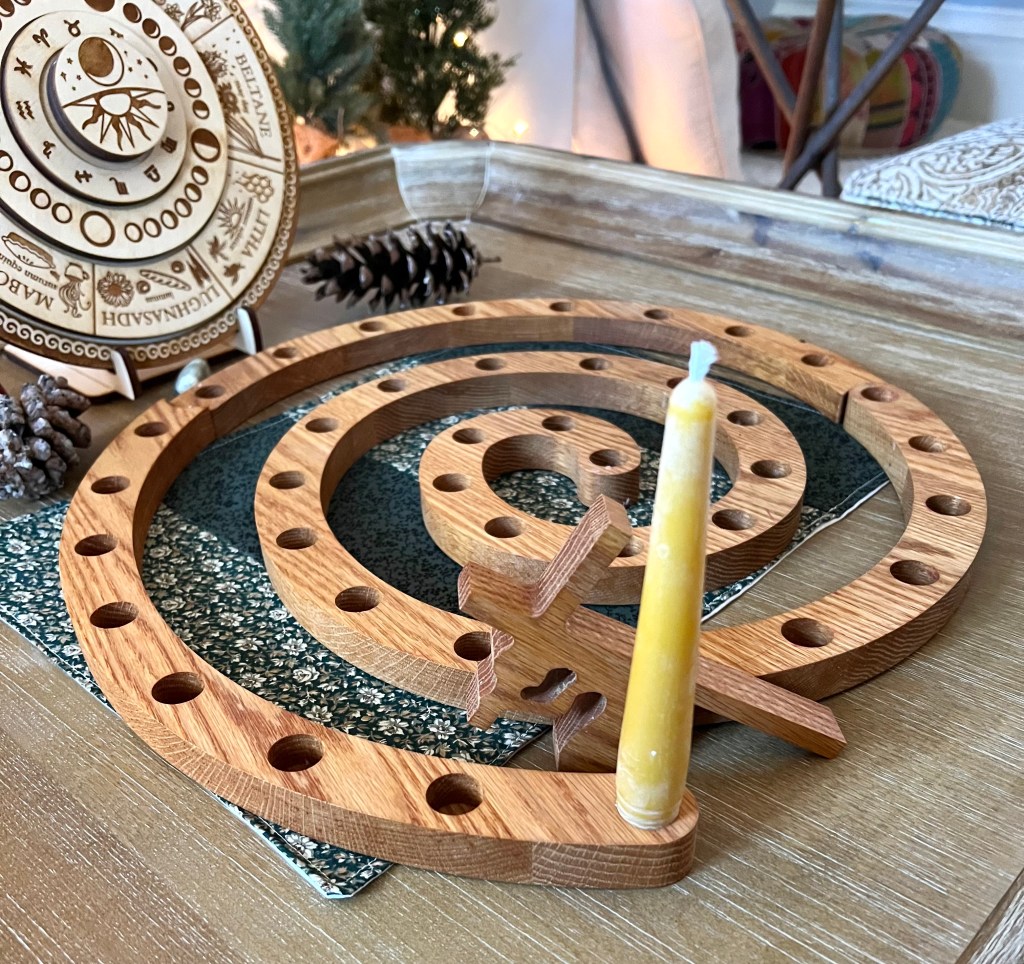
This morning I set out my Lenten spiral and spent a few hours decluttering and cleaning as I make room in my heart and living space for what Lent holds for me this year. I know what the traditional three aspects of Lent are: prayer, fasting, and almsgiving. And I also know the tendency of humans to turn Lent into a rules-based, rather than a heart-centered practice. It’s so easy to think, “I’m doing it better” or “She’s doing it wrong” and miss the point entirely.
In the past, I’ve done the giving up of sweets or wine or chocolate. And I’ve fasted from gossip or critical talk about myself or others. This year I am practicing laying down my burdens. I have some things I’ve been carrying for several years, looking backward with regret and anguish over my perceived wrongdoings and mistakes. As if I could go back in time or make anything right that way. Our minds know we can’t but feelings can take a lot longer. Grief takes as long as it takes.
But as I wrote about on Substack yesterday, I finally feel ready. I am letting all of that go. I’m laying it down as Lent starts. I know burdens are not so easily gotten rid of when we’ve carried them for so long. So I will have to practice this letting go. Again and again. Fasting from these burdens of shame, guilt, regret, punishing myself, etc.
Last night I finished reading Yung Pueblo’s book Inward. Serendipity surprises me with its stunning ability to appear at just the right time. I started Inward last year and then all these months later right where I picked it up was right where I needed to read. From the first page I started reading he mentions releasing burdens, loving oneself, liberation, healing, etc.
Page 111 says:
letting go is medicine
that heals the heart

letting go is a habit
that requires practice

letting go is best done
through feeling, not thinking

Page 186 says:


she's an explorer,
unafraid to travel
within her heart and mind,
ready to discover new places
to heal--releasing burdens
and planting wisdom wherever
her awareness takes her.

Page 197:
The forces
of the universe
support those
who work at
healing themselves

And page 210:
as our ability to
know and heal ourselves
deepens, we will be better
equipped to examine the
world more carefully
and heal it more
effectively
So back to Lent. I will be practicing this laying down of burdens this Lenten season. As I usually choose a book to read for Lent, this year I am reading Christine Valters Paintners’ A Different Kind of Fast: Feeding Our True Hungers During Lent. The chapters all seem to resonate with what I’m hungering for and will support my ongoing spiritual deconstruction.
She wrote each chapter as an invitation: Ash Wednesday Week starts with Fast from Consuming and Embrace Simplicity; Week 1 is Fast from Multitasking and Inattention and Embrace Full Presence to the Moment; Week 2 is Fast from Scarcity Anxiety and Embrace Radical Trust in Abundance; Week 3 is Fast from Speed and Rushing and Embrace Slowness and Pausing; Week 4 is Fast from Holding it All Together and Embrace Tenderness and Vulnerability; Week 5 is Fast from Planning and Deadlines and Embrace Unfolding and Ripening; and the last week is Fast from Certainty and Embrace Mystery and Waiting.
So this is what I’m purposing and what I’m reading for Lent. If you’re an observer of Lent, perhaps you’d like to join me in reading through Paintners’ book A Different Kind of Fast: Feeding Our True Hungers During Lent. I’m opening up a private chat for paid subscribers of my Substack, Old Soul Stories, to share thoughts, questions, experiences of reading this book during the Lenten season. I’d love to connect with you there. You can subscribe here.
If you observe Lent, what are your thoughts or plans for this season?
Now that we’re past Quitter’s Day (Jan. 19) and perhaps some of us see more clearly which New Year goals will stick and which ones we might not be ready for quite yet, let’s talk about discipline.
Discipline can have so many negative feels, right? Just hearing the word “discipline” reminds me of punishment when I was a child. I’ve been letting this word roll around in my mind for a couple of weeks because I know how unfavorable it might sound to say we need more of it. When people in power over us such as bosses, teachers, or parents are doling out the discipline, it might not feel good. But what if we discipline ourselves? What if self-discipline is the thing that makes us stronger, happier, healthier? What about disciplining ourselves to do the things we really want? To be the people we long to be?
I heard a statement a few months ago that said, “We have to show up for our future selves today. We have to be that person now.” If you want to learn some Portuguese for a trip you’re taking to Brazil in eight months, you can’t spend night after night on the couch watching tv. You have to break out Duolingo and practice each night. Or before you know you’ll be in Rio knowing not even the most basic phrases.
Once you know the kind of life you want to have, the relationships, work, health, finances, etc., then what? Do you just keep wishing in a dreamy kind of way? Do you get out your crystals, set your intentions, and wave some smoke around at the New Moon? Do you write in your manifestation journal or meditate?
These are all helpful to do, but how and whether we reach our goals depends on whether we do the thing. Every day or every week. Consistently. When no one is watching. When we don’t feel like it. When we’re tired or bored or would rather go binge-watch something. Focused time toward those intentions we set or revisit each New Moon.
For example, I’ve been “dreaming” of getting a collection of poems self-published before I’m 50. That’s a doable goal…if, and only if I write the poems, edit, and rewrite, and learn all the technical steps required to self-publish. Otherwise, I’ll be dreaming of publishing that collection before I’m 60. I must discipline myself to do these things and, as Brendon Burchard would say, put it on the calendar. If it’s not scheduled, it’s not going to happen. A dream is not a goal.
I actually have lots of dreams and goals. And many of them have definitely happened. I wanted to become an aromatherapist so I completed a training. I wanted to become a meditation teacher so I completed a training. I wanted to become a yoga teacher so I completed three different trainings. Some of the work was interesting and exciting (especially when starting a new program) and some of it was dull and definitely not exciting (especially after I’d been in the training awhile.)
When I look back on each of those trainings, I had to give them my intention, attention, and willpower. Intention was the “I want to be a yoga teacher” part, for example.Attention was my focus: taking notes and attending classes. Willpower came in when I had a list of steps for certification that I had to systematically work through and complete. When I didn’t feel like it. When I was feeling tired or lazy or even afraid I wouldn’t know what to do or I wouldn’t be good enough. No one could do the work for me. It was up to me and my will. I could either do it or not.
The discipline was setting aside time to complete the work. And it wasn’t negative even if I didn’t feel like doing it because I had set my intention to be a yoga teacher. People like to mention “your why” these days and, I agree, why you do something is important. So is “your what”. How did it start? “I want to be a yoga teacher”. There was a why too: “I want to teach people who are intimidated by yoga they see on Instagram or in magazines, people who are less flexible or not in a slender or young body. I want to show them that yoga is for them with the body they have and that they can experience the benefits of a physical yoga practice with simple and doable poses.”
On the days I doubted myself or didn’t feel like doing the work for yoga teacher certification, I could look back at my intention which was “my what”: that I wanted to be a yoga teacher. This helped me remember that I signed up for this work; I chose this path. At the beginning of goal-setting or intention-setting or a new program, there’s so much high and positive emotion that you think everything will be easy and exciting every day. So you do the work or check the thing off your list for a few days. Then you get bored; all the shine has worn off.
This is where self-discipline comes in. It’s not about how you feel. It’s acting with purpose and clarity toward your intention or goal. Toward “your what” and “your why”. Toward your future self. Once you set your intention, you can revisit it daily, weekly, monthly. And ask yourself if this intention still holds true or does it need to change. It’s fine if it does. But if you are still intending toward a future goal, discipline will bring you closer and closer to your goal.
You can speak to yourself kindly and encouragingly. Disciplining oneself doesn’t have to be cruel and harsh! You can channel your inner Louise Hay with some affirmations: “My intention is to become a yoga teacher and I am willing to do the work required to reach this goal. I am happy for the opportunity to take this training and learn so many wonderful new things. I am grateful for the instructors and fellow students I’ve gotten to know during this training and look forward to what this certification will afford me.”
When you finally climb up the hill and reach your destination, you will feel the satisfaction of completion and accomplishment. You will feel confident in your ability to figure things out, work hard, learn, and finish something. And then in that new confidence, you’ll probably set another goal and start the process over.
This post contains Amazon affiliate links. If you click through and make a purchase, I will receive a small compensation at no extra cost to you. This helps keep my blog ad-free.
Since I went gluten free eleven years ago, I’d never tasted a homemade waffle. I made regular waffles for my kids when they were at home and purchased frozen waffles for myself whenever I had a hankering for some. Until 2024! As soon as the new year was born I began to think about waffles. Alan had an old waffle maker from before my time, so I dug it out, cleaned it up, and mixed up some gluten free batter.
Complete fail! The waffle maker must’ve lost its nonstick coating because the first waffle stuck to the surface even after I’d oiled it. So I dug it all out (with a plastic utensil) and started over. This time the waffle maker stuck together like glue. No manner of pulling could pry it apart. So that one went into the landfill and I made the rest of my batter into an unsatisfactory pancake. I was so sad because I’d felt so virtuous cleaning up the waffle maker and putting something old to use again. Unfortunately, it wasn’t old old, it was just early 2000’s old which means it was built for obsolescence.
Then I fumed, hemmed, and hawed for a couple of days, wondering what the best solution was and still craved waffles. I decided to purchase this Cuisinart waffle maker because the design was simple, it had lots of good reviews, and the price was right. I didn’t want bells and whistles; I just wanted it to make good waffles.
The day after it came, I read all the instructions, wiped it down with soap and water, brushed oil on it and plugged it in. I whipped up a new batch of batter in the blender this time, (I will always mix GF waffle batter in the blender from now on), poured in my first half cup of batter and closed the top. Success!!! It didn’t stick, the batter didn’t pour out the sides (the bane of waffle making!), and the waffle tasted delicious.
I made the whole batch, cooled the ones I didn’t eat on a baking rack, and then froze them in a single layer on a baking sheet in the freezer. Once frozen, I popped them into a zip-top bag and put them back in the freezer. Because the size of the waffle is too big to reheat in the toaster, I put it in the toaster oven to defrost. (I tried breaking one up into fourths and defrosting half at a time in my little two-slot toaster but by the time the second half was ready, the first was cold.)
After eating eggs and toast for years, I’ve been switching it up with eggs and a waffle. I’m sure I’ll tire of them after a while, but right now they’re really making my mornings happy. Since I’m not drinking coffee right now, mornings have been a bit hard to face, to be honest. I LOVE coffee, even the decaf I’ve been drinking after I turned forty. But I was having so many health problems and after reading that coffee is a significant source of mold, I decided to cut it out of my diet, along with some other things, at least for now. Every morning it’s a battle as I remind myself of all the ways my health seems to be improving after only ten days but it’s still difficult not to give in. I keep looking at the calendar asking, “Hasn’t it been at least a month yet?”
I don’t recommend using cooking spray on your non-stick waffle maker surface. Use oil and a silicone brush. Olive oil, sunflower oil, refined coconut oil–any of those oils are great. Cooking spray has other stuff added besides just oil and it will gum up your waffle maker. In fact, I don’t recommend cooking spray on anything and haven’t used it in about fifteen years. A silicone brush or a paper towel and some oil work just fine.
I used my own gluten free flour blend to make the waffles. I mix up a good amount of flour all at once so I have it for several weeks at a time. (Here’s my gluten free flour recipe: 4 cups brown rice flour, 2 cups sorghum flour, 2 cups tapioca flour/starch, 1 cup arrowroot powder/starch/flour, 5 teaspoons xanthan gum. Mix really well and store in an airtight container.)
If you use the gluten free waffle recipe above, put your waffle ingredients in a blender if you have one. You can blend in a stand or hand mixer, but there will likely be lumps. Just put in the liquid ingredients first and then the dry ingredients and blend, scraping down the sides with a spatula a couple of times. Then transfer to a bowl while you make the waffles.
And if you spring for this Cuisinart waffle maker I just purchased, only use a half cup of batter at a time. Pour it into the middle and spread with a spatula, close the top and let it do its thing. Just once I put in a little more than half a cup and the batter oozed out all around which is what used to happen when I made regular waffles years ago in a two dollar garage sale waffle maker for my kids. And that’s what made made me think I hated waffle making. So whatever instructions come with your waffle maker, read them and find out how much batter exactly to pour in. It will make for a very pleasant experience and you likely will make waffles much more often.
Let me know if you make gluten free waffles (these or others) and share your tips!
This post contains Amazon affiliate links. If you click through and make a purchase, I will receive a small compensation at no extra cost to you. This helps keep my blog ad-free.
Earlier this year I seemed to be running into the theme of edges and margins over and over. People who live on the edges of society. People who live in the margins on purpose to have the life they want. And what plants grow on the edges of fields, gardens, at the side of the road.
At the edge of something a transition can happen. When you get to the edge of your cultivated garden or even a farm field, what we like to call “weeds” grow in these neglected, undernourished places. Cultivation by humans ends here and the wild begins. Nature restores the land as wild by bringing in seeds that grow into plants that improve the soil and hold it in place, and feed native insect and animal species.
People who are part of a community, but feel mostly like they don’t quite fit, are at the edges. They’re the observers of the culture, the ones who see what’s coming, what’s about to change. The loneres, the seers, the oracles, the forerunners, or the Enneagram 4’s, of which I am one.
Earlier this year, watched a documentary about a family who does their best to live by the principles of permaculture (earth care, people care, fair share) and they do the least amount of work in exchange for money/outside jobs so that they can spend more of their time with each other. They gave up a lot of modern conveniences so they can live simply, which means doing a lot of work by hand just to survive. This is important to them, so they’re in the world, but just barely. They’re at the edges. They live a rather uncomfortable life for modern-day humans to stand by their ideals.
When you get to the end of a visit with family, there is that edge that blurs a bit (maybe with tears) as you say goodbye to your loved ones and drive away or watch them do so. I always find it takes me at least a day to acclimate to my usual life and adjust to them not being there, or to my having returned home. There is an edge when I leave them and a transition as I get back into my normal routine. I feel sad, like pieces of myself have gone with them. I’m unsure, out of sorts, and have to work my way through time until I feel more settled in myself.
Edges are uncomfortable and something I would probably avoid if I could. It would be less painful to seamlessly go from one experience to another without that transition, that in-between time. That bump in the road that marks before and after, then and now, this experience and that experience. Is comfort always in our best interest, though? It hurts to grow. It is unsettling to change, to be in-between. Yet we need challenges to change and mature.
I am living in the edges of my spiritual life. I was a charismatic Christian for the first 39 years of my life, albeit a questioning and a bit rebellious one. And then I found I couldn’t accept everything that was taught at face value anymore. I had to leave church. I didn’t fit the mold in many different ways and so I stepped into the wild. It’s been seven and a half years and I’m still in the edges. In the wild places. As I’ve read, pondered, thought, learned about and discussed spirituality from many sources, I’m less certain of some things and more sure of others. For instance, I no longer believe the Divine is exclusive to the Jews and Christians. How could I have even thought that? I used to struggle with those big questions such as:
Until Jesus came and died on the cross so people had a chance to accept salvation, where did those people go when they died?
And before Christ’s time, was it only the Jewish people who could be saved through their constant sacrifices and obeying rules and all the other nations out there went straight to hell because they weren’t Jewish?
And why are Christian people afraid of “Eastern religions”? Where do they think Christianity came from? I mean, I realize it’s been Westernized and even worse, Americanized, but do they really think Jesus was a white man who preached a lot of the stuff one hears in conservative circles today? About property and gun rights and hating certain groups of people because they’re different than us?
I could no longer go along with the idea that because the Bible was written in a time when women were not even considered people, we are still going to follow what is written about women today.
In spite of the fact I’ve parted ways with the church, I still find beauty in some aspects of Christianity. In some of the poetry and prophecies in the Bible; the classical sacred music; some of the liturgy, but that’s where it ends. I am tired of listening to men write books and blog posts about what they think God meant when he said this or that. I am tired of people being afraid of anything that doesn’t have a “Jesus Saves”, “God Bless You”, or “Hallelujah” stamped on it. Of people meeting raw grief, depression, questioning, etc., with a pat verse or cliche instead of sitting with them and holding their hand in their dark night of the soul.
What I am edging into is Celtic spirituality, nature-based, wild, and in the margins. I am searching for more of the sacred feminine in my spiritual experience. I am craving connection with a community yet don’t know if I can deal with the compromises involved in belonging to one. Rachel Held Evans, in her book, Searching for Sunday, admonished readers not to wait for the perfect church or spiritual community because it doesn’t exist. And I know she’s right. I’m just not willing at this point to belong to something that I can’t commit to 100% and that feels completely congruent with the deep, inner places of my heart.
Maybe it’s because I’m still living in the wild places; at the edges and margins of spirituality. I’ve changed so much in the past seven and a half years and will continue to. If you’re living in the margins, in any sense, but especially with your spiritual life, all you can do is keep your heart open; keep seeking, keep listening and asking. God/Goddess/the Divine hasn’t changed. Love hasn’t stopped singing over us and drawing us into an embrace. You are just as loved and just as watched over as those who feel solid in their spirituality. We are all loved, and still precious, still valued, even if we are living in the wild places, at the edges.
How are you feeling concerning what’s happening in the world right now? If you could settle on one emotion, to get to the root of all the other emotions you might be experiencing, is it fear? It seems to me, from listening to people over the past couple of weeks, that fear is very strong. Many of us are living in survival mode and in that state of fight, flight, freeze, or fawn. I am mostly noticing the fighting–those who are angry and loud, and the freezing–those who are staying still and quiet. And it’s all because we’re scared.
What can we do with all this fear? Have you spent the past few weeks walking in circles, not taking care of yourself, self-medicating with too much screen-time and too much junk food? Too much wine? In a daze? In a funk? Not knowing what to do with the worry and anxiety? This is probably the norm and I’ve felt it too. However, staying stuck in our heads and abandoning our bodies and the world immediately around us will not help anyone. It won’t help people who are suffering and it won’t help us to be supportive of those we care about.
Even in the midst of worldwide chaos and uncertainty, we can set a table, light a candle, and sit down together for a wholesome meal. (Do you remember that last scene in the film Don’t Look Up when they made a meal and all sat down together even though they knew it was their last supper?) We can take a walk in the sunshine or in the lashing rain. We can pick up clutter, fold the laundry, and take out the recycling. When life is chaotic, we need to bring order and beauty into our lives. This is our defiance against the darkness, as Sarah Clarkson so aptly put it in a recent podcast episode.
This is our work. And this is part of our love for the world. It starts with us. Love your neighbor as yourself, says that Golden Rule. Yes, we pray, weep, march, or call our elected officials to change things. But first, we love ourselves and care for what we have. We don’t know what tomorrow will bring, but we have today.
Why? You fill your own cup first so you’ll have something for yourself and to give others. Fill your own lamp so you can light the way for yourself and others. Only you know what this means for you. For me, this means my early morning practices. What I do before others need me and the day really begins. This usually includes: prayer, meditation, yoga, my morning pages, inspirational reading, exercise, a good breakfast, my herbs and other supplements. If I do these things, I feel strong and ready for what comes. Much more so than if I roll out of bed groggily and too late for these practices and have to answer emails and complete tasks right away. What I do first thing affects the rest of my day, replenishes me spiritually, emotionally, physically, and mentally.
Another way to think about it is to take care of what you have. Our job is not to worry about tomorrow, but to live our lives fully today. And part of this is to take care of what you have. Don’t neglect your responsibilities. You live in a body, so care for it. Feed it delicious food that delights the senses and that will help you to feel your best. If you’re an adult, you must know by now which foods make you feel alert and energized and which ones make you feel dull and sluggish. Exercise every day. Whether it’s ten minutes of stretching, an hour-long class, a walk, a run, Pilates, whatever, just move your body. Remove clutter and tidy up your living areas. You experience more calm when your living space is clean and orderly than if it’s a disaster. If you’re not good at this, no excuses–learn how. If you’re reading this, you have access to the internet which means you can learn how to do nearly anything. And donate whatever you don’t find beautiful, useful, or haven’t used in a year so you can live lighter and will have less to keep clean.
These are just a few examples of what we can do when life is chaotic. The go-to might be to comfort ourselves by overeating, not moving, and letting our lives fall apart, but that is actually not comfort as I posted about in the spring. The etymology of the word “comfort” means to strengthen much, to give or add strength to. Not much strengthening is happening when we’re eating a whole bag of chips, tankards of beer, and watching a whole season of some Netflix show while the house goes to rack and ruin around us. We are actually weakened by this.
So, love yourself today and give yourself a chance to feel more calm, strong, and centered by taking care of yourself, by filling your own cup first. Because we are needed to be lamps in the dark for others. To point the way toward goodness, peace, love, and beauty.
This post contains Amazon affiliate links. If you click through and make a purchase, I will receive a small compensation at no extra cost to you. This helps keep my blog ad-free.
Last night I attended a women’s circle for the very first time. It was led by Molly Remer, author of Walking With Persephone, (recommended for mid-life women), as well as several books of poetry and prayers, and co-owner of Brigid’s Grove. Molly leads a goddess-centered life and her books, journals, products, and online offerings reflect this.
Take a deep breath. Inhale deep, exhale long and slowwww. You are not in danger of being eaten by a bear. Because if you’re part of a religion with only male god/gods, the word “goddess” can sound very upsetting and threatening to your belief system. My roots are in Christianity so I know a lot about male-centric religion and the fear associated with thinking outside those parameters.
What I’ve been learning over the past several years is that much of the world worshipped either female only or female and male deities for much of human history. The church came crashing in and tried to stamp out spirituality that was connected to females or the earth. Celebrations and feast days were stolen and replace with Christian ones with Christian saints to celebrate and pray to.
Let me be clear that I still love Christ and love everything I’ve learned so far about him. I still love the story of his miraculous and humble birth, his love for the poor, sick, weak, and “sinful”, his way of speaking out against hypocrisy and the burden of religious expectation. His compassion. His love for others. Even though I’m not in a church anymore, I still listen to lovely choral music or even worship songs and sing them sometimes. I still read the Psalms and other parts of the Bible that uplift and encourage.
But I’m curious, too, about the myths and stories of goddesses from the past, and, in particular, Celtic spirituality (sans human sacrifice, of course.) The old ways. Even Jeremiah 6:16 says, “Stand at the crossroads and look; ask for the ancient paths, ask where the good way is, and walk in it, and you will find rest for your souls.”
That’s what I’m doing. I’m standing at the crossroads, searching, asking for the ancient paths. Asking where the good way is. Not the white American evangelical or charismatic Christian versions of the good way. Something much further back in time than that. More wild than that. What’s at the edges, not the mainstream. Ok, enough of defending my why.
I went to Molly’s circle and was welcomed in immediately. It was a sweet, and dare I say, sacred space. No one was praying to anyone or doing demon worship or muttering scary words. Nothing made me feel on alert, afraid, constricted, or freaked out. It was just a group of women reading some poetry, discussing what mystery meant to them, listening to a song, reading a little more poetry, journaling, a little more discussion, and closing (on time) with a blessing (again, with no weird words). Everyone was kind, respectful, and listened more than they spoke. This was the first time I’ve ever felt comfortable sharing in an online group. And I was really glad I decided to go.
So that was my experience at a women’s circle last night. I plan to attend next month as well. I’d love to hear if any of you have ever been to women’s circles outside of a church setting and what it’s been like for you.








 Life of Kim