For those of us who observe the Christian liturgical year, we have come to the end of Lent, and are now in the Easter season. Lent always feels long and this year even more so with what is happening here in the US and around the world.
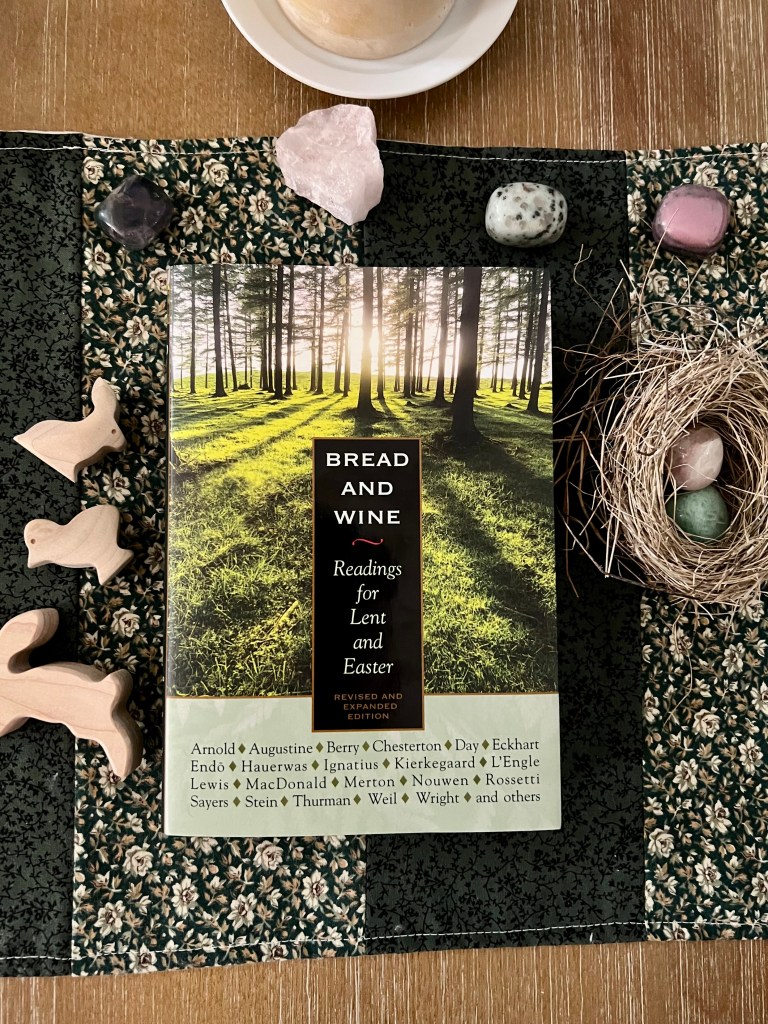
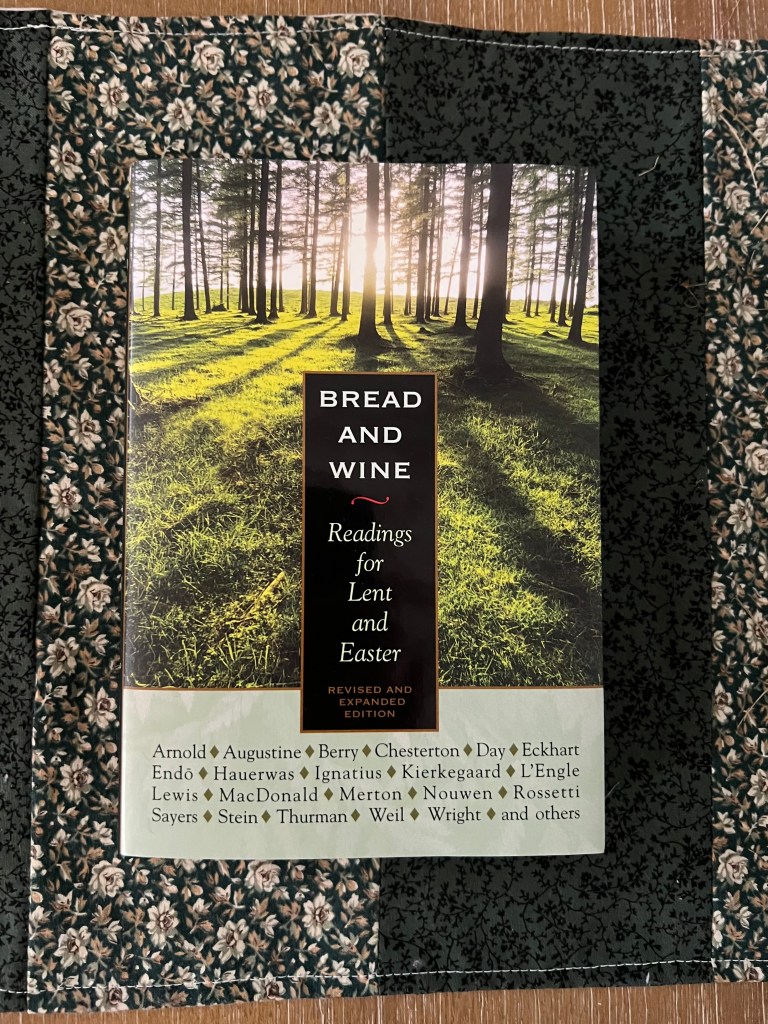
When I am feeling the cold and bleakness of Lent, or when I am feeling anxious and fearful, I am always thankful for the words of wise people who have gone before me. And this is why Bread and Wine: Readings for Lent and Easter, is a book I’ve kept close by throughout the Lenten and Easter seasons for many years. When my own faith wavers or my spiritual fire gets low, I can be inspired and uplifted by the insights and experiences of others, which fan the flame of my own spiritual hunger, and help me to keep walking.
Within these pages, I read (and re-read each year) passages from Barbara Brown Taylor, Wendell Berry, Amy Carmichael, Karl Barth, Thomas Merton, Henri Nouwen, Dorothy Day, and Dorothy Sayers, plus many more.
And I’ve been encouraged by these readings, such as by these words from Kahlil Gibran in the chapter entitled “The Crucified”:
“Jesus was not sent here to teach the people to build magnificent churches and temples amidst the cold wretched huts and dismal hovels. He came to make the human heart a temple, the soul an altar, and the mind a priest.”
Or from the chapter entitled “Not All Right” from Tish Harrison Warren:
“The ones Jesus calls are the weary ones, the ones who snap at those they love after a long day, the ones who battle addiction, the ones who aren’t who they wish they were, the ones who know they are not strong, the ones who wrestle and repent, who fail and fail again. This is the church, these ones through whom Jesus is strong.”
Or “Waiting With Mary” by Kathleen Mulhern which both honors Mary’s experience as mother and disciple of Christ and helps us imagine what it must have been like for her as he was crucified, buried, and resurrected.
If Lent is a season you observe, Bread and Wine may also become for you a companion to take you through the reflective season of repentance, fasting, and prayer to the celebration of Easter and beyond, all the way to Pentecost. Find Bread and Wine: Readings for Lent and Easter at your local bookstore, online at Bookshop.org and Amazon.
I am still getting over Covid, which I had earlier in the month. As someone with asthma, allergies, and some other chronic conditions, it’s taking me longer than I’d like. So, I’ve been reading several books and watching a lot of shows during my downtime.
Let’s start with the poem: I came across it while searching for a John O’Donohue poem for this Substack post I wrote about peace. John O’Donohue wrote in a way that drew his readers toward wisdom, nature’s beauty and the deep things of the soul. His poetry soothes me like the arms of a loving mother: comforting, clear, and kind.
Blessing For Peaceby John O’Donohue (from his book Benedictus)
As the fever of day calms towards twilight May all that is strained in us come to ease.
We pray for all who suffered violence today, May an unexpected serenity surprise them.
For those who risk their lives each day for peace,
That those who make riches from violence and war Might hear in their dreams the cries of the lost.
That we might see through our fear of each other A new vision to heal our fatal attraction to aggression.
That those who enjoy the privilege of peace Might not forget their tormented brothers and sisters.
That the wolf might lie down with the lamb, That our swords be beaten into ploughshares
And no hurt or harm be done Anywhere along the holy mountain.
Next, the two books I finished this past weekend both left me inspired and encouraged. The first is Elaine Paigels’ Miracles and Wonder: The Historical Mystery of Jesus. I wasn’t sure if this would be the sort of book so high-minded and intellectual that the gospels would be torn into tatters or presented as simply myths.
Instead, Paigels presents any historical evidence there might be to support the stories while also clearly sharing what isn’t there. She looks at topics such as Jesus’ virgin birth, his resurrection, his claim to be God and doesn’t mock or tear down anyone’s faith. She just shares facts that are known and leaves it up to the reader to choose what to believe from there. Paigels, is, after all, a historian of religion, so I would say she did her work thoroughly. If you want to read more about the life of Christ from a historical perspective, I recommend this book.
The second book I read was Ordinary Mysticism: Your Life as Sacred Ground by Mirabai Starr. This book encourages us to find the sacred and the divine in everything we do, everywhere we go. To hear the voice of God in birdsong or our partner’s voice, to connect to Divine Presence anywhere we happen to be: a meditation room, a church, at work, in the garden, making dinner. She pulls in the voices of famous mystics like Teresa of Avila and St. John of the Cross, Ram Dass and Thich Nhat Hanh, and everyday people she knows such as a writer friend and the woman who does her nails at the local salon.
Mirabai is so welcoming of others’ experiences, opening up the way for any of us to be mystics, to support and enrich our spiritual lives wherever we are and whatever we are experiencing. I also really appreciated her chapter on grief and how grief connects us to the Divine and to one another. I recommend this book if you’re looking to enhance your spiritual life.
Now for the three British TV shows:
Lynley is the latest TV rendition of Elizabeth George’s ongoing DI Lynley mystery series. If you’re familiar with the books or the earlier Inspector Lynley series from the late 1990s/early aughts, this is a fresh take. The mysteries were interesting enough to keep me guessing and the new versions of both the aristocratic Thomas Lynley and his detective sergeant side-kick, Barbara Havers were likable enough. Their chemistry is a bit different, as Lynley’s and Helen’s, his love interest. It has gravitas but doesn’t get depressing and adds just enough lightness to keep it balanced.
Playing Nice is a four-episode suspense/drama about a couple who find out that their son is not their biological child. The boy who they’ve raised as their own was switched with their biological son in the NICU. Their lives unravel quickly as a sociopath attempts to not only take the son they’ve raised, but prevent them from ever seeing their biological son. Starring James Norton of Grantchester and Happy Valley and Jessica Brown Findley of Downton Abbey.
Line of Duty is a police show and I watched all six seasons this month. AC-12 is a police department whose purpose is to root out corruption in the police force and catch bent cops. It’s intense and, if you like this sort of show, it’ll be difficult to stop at the end of each episode! Each season, there is a particular police officer connected to a suspicious incident that AC-12 is investigating, often undercover. The good news is a seventh season is in the works.
What have you been reading and watching lately? Please share in comments!
This post contains Amazon affiliate links. If you click through and make a purchase, I will receive a small commission at no extra cost to you. This helps keep my blog ad-free.
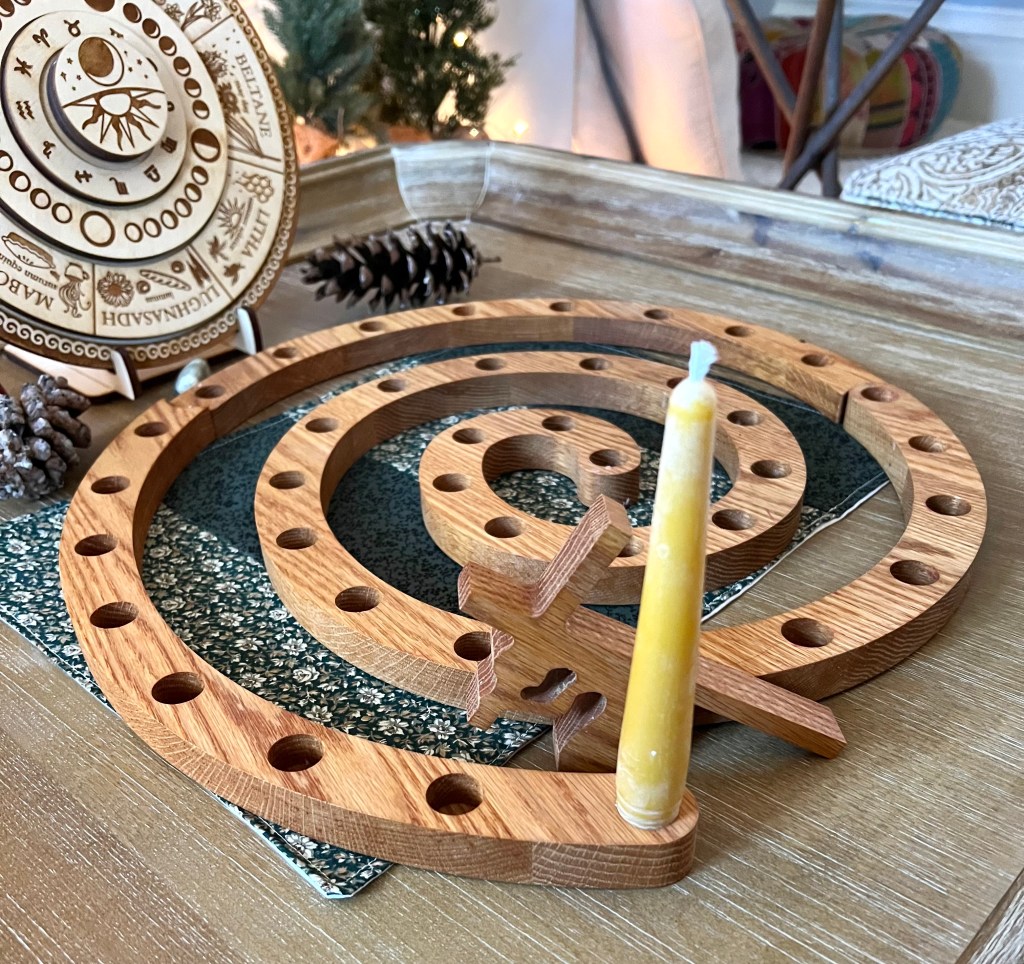
This morning I set out my Lenten spiral and spent a few hours decluttering and cleaning as I make room in my heart and living space for what Lent holds for me this year. I know what the traditional three aspects of Lent are: prayer, fasting, and almsgiving. And I also know the tendency of humans to turn Lent into a rules-based, rather than a heart-centered practice. It’s so easy to think, “I’m doing it better” or “She’s doing it wrong” and miss the point entirely.
In the past, I’ve done the giving up of sweets or wine or chocolate. And I’ve fasted from gossip or critical talk about myself or others. This year I am practicing laying down my burdens. I have some things I’ve been carrying for several years, looking backward with regret and anguish over my perceived wrongdoings and mistakes. As if I could go back in time or make anything right that way. Our minds know we can’t but feelings can take a lot longer. Grief takes as long as it takes.
But as I wrote about on Substack yesterday, I finally feel ready. I am letting all of that go. I’m laying it down as Lent starts. I know burdens are not so easily gotten rid of when we’ve carried them for so long. So I will have to practice this letting go. Again and again. Fasting from these burdens of shame, guilt, regret, punishing myself, etc.
Last night I finished reading Yung Pueblo’s book Inward. Serendipity surprises me with its stunning ability to appear at just the right time. I started Inward last year and then all these months later right where I picked it up was right where I needed to read. From the first page I started reading he mentions releasing burdens, loving oneself, liberation, healing, etc.
Page 111 says:
letting go is medicine
that heals the heart

letting go is a habit
that requires practice

letting go is best done
through feeling, not thinking

Page 186 says:


she's an explorer,
unafraid to travel
within her heart and mind,
ready to discover new places
to heal--releasing burdens
and planting wisdom wherever
her awareness takes her.

Page 197:
The forces
of the universe
support those
who work at
healing themselves

And page 210:
as our ability to
know and heal ourselves
deepens, we will be better
equipped to examine the
world more carefully
and heal it more
effectively
So back to Lent. I will be practicing this laying down of burdens this Lenten season. As I usually choose a book to read for Lent, this year I am reading Christine Valters Paintners’ A Different Kind of Fast: Feeding Our True Hungers During Lent. The chapters all seem to resonate with what I’m hungering for and will support my ongoing spiritual deconstruction.
She wrote each chapter as an invitation: Ash Wednesday Week starts with Fast from Consuming and Embrace Simplicity; Week 1 is Fast from Multitasking and Inattention and Embrace Full Presence to the Moment; Week 2 is Fast from Scarcity Anxiety and Embrace Radical Trust in Abundance; Week 3 is Fast from Speed and Rushing and Embrace Slowness and Pausing; Week 4 is Fast from Holding it All Together and Embrace Tenderness and Vulnerability; Week 5 is Fast from Planning and Deadlines and Embrace Unfolding and Ripening; and the last week is Fast from Certainty and Embrace Mystery and Waiting.
So this is what I’m purposing and what I’m reading for Lent. If you’re an observer of Lent, perhaps you’d like to join me in reading through Paintners’ book A Different Kind of Fast: Feeding Our True Hungers During Lent. I’m opening up a private chat for paid subscribers of my Substack, Old Soul Stories, to share thoughts, questions, experiences of reading this book during the Lenten season. I’d love to connect with you there. You can subscribe here.
If you observe Lent, what are your thoughts or plans for this season?
This post contains Amazon affiliate links. If you click through and make a purchase, I will receive a small compensation at no extra cost to you. This helps keep my blog ad-free.
Earlier this year I seemed to be running into the theme of edges and margins over and over. People who live on the edges of society. People who live in the margins on purpose to have the life they want. And what plants grow on the edges of fields, gardens, at the side of the road.
At the edge of something a transition can happen. When you get to the edge of your cultivated garden or even a farm field, what we like to call “weeds” grow in these neglected, undernourished places. Cultivation by humans ends here and the wild begins. Nature restores the land as wild by bringing in seeds that grow into plants that improve the soil and hold it in place, and feed native insect and animal species.
People who are part of a community, but feel mostly like they don’t quite fit, are at the edges. They’re the observers of the culture, the ones who see what’s coming, what’s about to change. The loneres, the seers, the oracles, the forerunners, or the Enneagram 4’s, of which I am one.
Earlier this year, watched a documentary about a family who does their best to live by the principles of permaculture (earth care, people care, fair share) and they do the least amount of work in exchange for money/outside jobs so that they can spend more of their time with each other. They gave up a lot of modern conveniences so they can live simply, which means doing a lot of work by hand just to survive. This is important to them, so they’re in the world, but just barely. They’re at the edges. They live a rather uncomfortable life for modern-day humans to stand by their ideals.
When you get to the end of a visit with family, there is that edge that blurs a bit (maybe with tears) as you say goodbye to your loved ones and drive away or watch them do so. I always find it takes me at least a day to acclimate to my usual life and adjust to them not being there, or to my having returned home. There is an edge when I leave them and a transition as I get back into my normal routine. I feel sad, like pieces of myself have gone with them. I’m unsure, out of sorts, and have to work my way through time until I feel more settled in myself.
Edges are uncomfortable and something I would probably avoid if I could. It would be less painful to seamlessly go from one experience to another without that transition, that in-between time. That bump in the road that marks before and after, then and now, this experience and that experience. Is comfort always in our best interest, though? It hurts to grow. It is unsettling to change, to be in-between. Yet we need challenges to change and mature.
I am living in the edges of my spiritual life. I was a charismatic Christian for the first 39 years of my life, albeit a questioning and a bit rebellious one. And then I found I couldn’t accept everything that was taught at face value anymore. I had to leave church. I didn’t fit the mold in many different ways and so I stepped into the wild. It’s been seven and a half years and I’m still in the edges. In the wild places. As I’ve read, pondered, thought, learned about and discussed spirituality from many sources, I’m less certain of some things and more sure of others. For instance, I no longer believe the Divine is exclusive to the Jews and Christians. How could I have even thought that? I used to struggle with those big questions such as:
Until Jesus came and died on the cross so people had a chance to accept salvation, where did those people go when they died?
And before Christ’s time, was it only the Jewish people who could be saved through their constant sacrifices and obeying rules and all the other nations out there went straight to hell because they weren’t Jewish?
And why are Christian people afraid of “Eastern religions”? Where do they think Christianity came from? I mean, I realize it’s been Westernized and even worse, Americanized, but do they really think Jesus was a white man who preached a lot of the stuff one hears in conservative circles today? About property and gun rights and hating certain groups of people because they’re different than us?
I could no longer go along with the idea that because the Bible was written in a time when women were not even considered people, we are still going to follow what is written about women today.
In spite of the fact I’ve parted ways with the church, I still find beauty in some aspects of Christianity. In some of the poetry and prophecies in the Bible; the classical sacred music; some of the liturgy, but that’s where it ends. I am tired of listening to men write books and blog posts about what they think God meant when he said this or that. I am tired of people being afraid of anything that doesn’t have a “Jesus Saves”, “God Bless You”, or “Hallelujah” stamped on it. Of people meeting raw grief, depression, questioning, etc., with a pat verse or cliche instead of sitting with them and holding their hand in their dark night of the soul.
What I am edging into is Celtic spirituality, nature-based, wild, and in the margins. I am searching for more of the sacred feminine in my spiritual experience. I am craving connection with a community yet don’t know if I can deal with the compromises involved in belonging to one. Rachel Held Evans, in her book, Searching for Sunday, admonished readers not to wait for the perfect church or spiritual community because it doesn’t exist. And I know she’s right. I’m just not willing at this point to belong to something that I can’t commit to 100% and that feels completely congruent with the deep, inner places of my heart.
Maybe it’s because I’m still living in the wild places; at the edges and margins of spirituality. I’ve changed so much in the past seven and a half years and will continue to. If you’re living in the margins, in any sense, but especially with your spiritual life, all you can do is keep your heart open; keep seeking, keep listening and asking. God/Goddess/the Divine hasn’t changed. Love hasn’t stopped singing over us and drawing us into an embrace. You are just as loved and just as watched over as those who feel solid in their spirituality. We are all loved, and still precious, still valued, even if we are living in the wild places, at the edges.
This post contains Amazon affiliate links. If you click through and make a purchase, I will receive a small compensation at no extra cost to you. This helps keep my blog ad-free.
Last night I attended a women’s circle for the very first time. It was led by Molly Remer, author of Walking With Persephone, (recommended for mid-life women), as well as several books of poetry and prayers, and co-owner of Brigid’s Grove. Molly leads a goddess-centered life and her books, journals, products, and online offerings reflect this.
Take a deep breath. Inhale deep, exhale long and slowwww. You are not in danger of being eaten by a bear. Because if you’re part of a religion with only male god/gods, the word “goddess” can sound very upsetting and threatening to your belief system. My roots are in Christianity so I know a lot about male-centric religion and the fear associated with thinking outside those parameters.
What I’ve been learning over the past several years is that much of the world worshipped either female only or female and male deities for much of human history. The church came crashing in and tried to stamp out spirituality that was connected to females or the earth. Celebrations and feast days were stolen and replace with Christian ones with Christian saints to celebrate and pray to.
Let me be clear that I still love Christ and love everything I’ve learned so far about him. I still love the story of his miraculous and humble birth, his love for the poor, sick, weak, and “sinful”, his way of speaking out against hypocrisy and the burden of religious expectation. His compassion. His love for others. Even though I’m not in a church anymore, I still listen to lovely choral music or even worship songs and sing them sometimes. I still read the Psalms and other parts of the Bible that uplift and encourage.
But I’m curious, too, about the myths and stories of goddesses from the past, and, in particular, Celtic spirituality (sans human sacrifice, of course.) The old ways. Even Jeremiah 6:16 says, “Stand at the crossroads and look; ask for the ancient paths, ask where the good way is, and walk in it, and you will find rest for your souls.”
That’s what I’m doing. I’m standing at the crossroads, searching, asking for the ancient paths. Asking where the good way is. Not the white American evangelical or charismatic Christian versions of the good way. Something much further back in time than that. More wild than that. What’s at the edges, not the mainstream. Ok, enough of defending my why.
I went to Molly’s circle and was welcomed in immediately. It was a sweet, and dare I say, sacred space. No one was praying to anyone or doing demon worship or muttering scary words. Nothing made me feel on alert, afraid, constricted, or freaked out. It was just a group of women reading some poetry, discussing what mystery meant to them, listening to a song, reading a little more poetry, journaling, a little more discussion, and closing (on time) with a blessing (again, with no weird words). Everyone was kind, respectful, and listened more than they spoke. This was the first time I’ve ever felt comfortable sharing in an online group. And I was really glad I decided to go.
So that was my experience at a women’s circle last night. I plan to attend next month as well. I’d love to hear if any of you have ever been to women’s circles outside of a church setting and what it’s been like for you.
This afternoon I brought out all my advent books and am readying the wreath-of-sorts that I’ll be using this year. It’s simple: a plate with four beeswax taper candles and freshly cut evergreens to fill it in and make it more festive.
As I learn more about the traditions of other, older cultures and religions, I’ll admit to conflicted feelings when it comes to the Christian observances and celebrations I’ve come to hold dear. Christianity stole much of what was meaningful from “the pagans” and put its own name and “more holy” stamp on the seasonal feasts and holy days. The fact that this religion that I loved my whole life is attached to colonization, to genocide means that there is a darkness, a shadow side to it.
Where I am landing right now is within the word syncretism which is the combination of different forms of beliefs or practices. I have my roots in Christianity, for better or for worse, and that’s where I feel most at home, but my respect and interest in other belief systems grows all the time. I have added observances of other days including the Celtic wheel of the year.
But tomorrow, I will light the first candle amidst the darkness of these short days. I will sing a carol and ponder a reading in one of my many devotional books. And I will revel in the beauty and mystery of the story.
Another Advent candle arrangement from a previous year.
For the past few weeks, I’ve had higher-than-usual anxiety levels. Lots of activity and a full house are definitely part of it, plus the changing weather, and my ongoing post-divorce inner work/healing. Yes, I know, we’ve all got stuff to deal with and we have to do the best we can every day. So, here is a list of some of the tools that are helping me get my anxiety under control each day.
Calming Aromatherapy Blend:
(4 drops Cypress, 3 drops Lavender, 5 drops Sweet Orange essential oil.) When my anxiety seems to be peaking, this blend helps me almost instantly. I put it in my diffuser, sit down to work at my desk, and within 10-15 minutes I feel that tightness in my chest ease, the inexplicable sadness and worry lifts, and I come back to myself.
I’ve said it before and will say it again: This blend of B vitamins and herbs really works to calm me down, boost my mood, and relieve stress. Whether for everyday anxiety issues or for situational anxiety, (before a performance, for example), it works for me within twenty minutes. You should have this in your natural first aid kit.
Walking outside for at least twenty minutes each day.
Just get out there! Your mood will lift, your ability to focus improve, your stress levels will drop, and your overall sense of well-being will rise. Feel the sun or rain or wind on your face, connect with your surroundings, and remind yourself that you are part of the planet, and the planet is part of you.
Meditation/Yoga/Prayer/Pranayama:
Pick one or do all of them, but whether you are praying, practicing yoga, meditating or doing breathing exercises like Pranayama, you will benefit with lowered stress levels and a calmer, more positive outlook. I enjoy meditating and practicing yoga with the YogaGlo app on my phone.
Watching something that makes you laugh.
I can get so serious and stuck in my head, trying to solve problems and get work done, that I forget to take a break and just laugh. Whether it’s I Love Lucy episodes, a movie like Beauty Shop with Queen Latifah or a TV show like The Marvelous Mrs Maisel, a good laugh session will do wonders for your mood and you’ll stress less.
Reading books on contemplative prayer and mindfulness:
For the past several years I have been immersing myself in current literature. The book nerd in me is always becoming obsessed over the latest offerings from authors both familiar and new to me. Listening to bookish podcasts can be so exciting as I hear about books I’ve never heard of and add them to my To-Be-Read list.
When I homeschooled my kids, I read plenty of old books. There were read-aloud selections for History, Language Arts, for Music, Art, and for bedtime. And I read old books for my own learning and for pleasure. In my mind, “old” could mean something written 50 years ago or 300 years ago–or more! In the book God in the Dock, C.S. Lewis presents a case for old books in his essay entitled “On the Reading of Old Books”. This is a much-loved and repeated quote from this essay:
“It is a good rule, after reading a new book, never to allow yourself another new one till you have read an old one in between. If that is too much for you, you should at least read one old one to every three new ones.”
Why? What is the point of reading old books? Aren’t they irrelevant, stuffy, full of archaic words and ideas, and just plain difficult to understand? I’m sure some are, but there is so much we can learn from past ideas and perspectives, past ways of living and speaking.
Here are Lewis’s three reasons why you should read old books:
1.”First-hand knowledge is not only more worth acquiring than second-hand knowledge, but is usually much easier and more delightful to acquire.” Don’t choose a modern commentary on an ancient philosopher like Plato, for example. Instead, just read Plato. Lewis says you will be more able to understand Plato directly than some long-winded interpretation of the philosopher.
2. Avoid the nearsightedness of our own age. “Every age has its own outlook. It is specially good at seeing certain truths and specially liable to make certain mistakes. We all, therefore, need the books that will correct the characteristic mistakes of our own period.”
There is a certain “blindness” that today’s writers and thinkers have–“the blindness about which posterity will ask, ‘But how could they have thought that?’ “…”None of us can fully escape this blindness, but we shall certainly increase it, and weaken our guard against it, if we read only modern books.”…”The only palliative is to keep the clean sea breeze of the centuries blowing through our minds, and this can be done only by reading old books.” This will help us avoid making the same mistakes (aka history repeating itself)
3. To see the underlying theme of the Christian faith through the ages and not be swayed by modern “sub-Christian modes of thought”. Although there are many divisions within Christianity, there is a certain unifying thread running through the centuries of religious writings. Lewis has a substantial list of recommended reading, whether you are a seeker, a believer, or an emphatic unbeliever, as he was at one time.
So…of course this segues naturally into what old books are part of my spring/summer reading list. Here are the first four!
I’m re-reading Northanger Abbey by Jane Austen via audiobook. It’s been several years since I read any of her works, so I thought it was about time to pick up her books again. The incomparable Juliet Stevenson narrates this version and I highly recommend it!
Bede’s Ecclesiastical History of the English People is a book I only skimmed through while my son was studying the British Isles in eleventh grade. Since Alan and I are planning a trip to the UK in the next two years, I added this one to my reading list. This book was written in A.D. 731, so it is OLD, but not dull!
I just picked up The Essential Writings of Ralph Waldo Emersonthat contains an introduction by Mary Oliver. Although I’ve read quotes and passages by Emerson in the past, and have heard him referenced by countless others, I have never read “Nature” or “Self-Reliance”, his poetry or anything else of his. Have I been living under a rock all these years? It’s high time I get down to reading his works!!!
As it’s been years since I’ve read anything by the Brontes, other than Jane Eyre, I will be listening to Villetteby Charlotte Bronte when I finish Northanger Abbey.
I would love to hear what old books you are reading or plan to read this year!



 Life of Kim