This post contains Amazon affiliate links. If you click through and make a purchase, I will receive a small compensation at no extra cost to you. This helps keep my blog ad-free.
For a New Beginningby John O'Donohue
In out-of-the-way places of the heart,
Where your thoughts never think to wander,
This beginning has been quietly forming,
Waiting until you were ready to emerge.
For a long time it has watched your desire,
Feeling the emptiness growing inside you,
Noticing how you willed yourself on,
Still unable to leave what you had outgrown.
It watched you play with the seduction of safety
And the gray promises that sameness whispered,
Heard the waves of turmoil rise and relent,
Wondered would you always live like this.
Then the delight, when your courage kindled,
And out you stepped onto new ground,
Your eyes young again with energy and dream,
A path of plenitude opening before you.
Though your destination is not yet clear
You can trust the promise of this opening;
Unfurl yourself into the grace of beginning
That is at one with your life's desire.
Awaken your spirit to adventure;
Hold nothing back, learn to find ease in risk;
Soon you will home in a new rhythm,
For your soul senses the world that awaits you.
You can find this poem in To Bless The Space Between Us: A Book of Blessings.
This post contains Amazon affiliate links. If you click through and make a purchase, I will receive a small compensation at no extra cost to you. This helps keep my blog ad-free.
Ox-Cart Man
by Donald Hall

In October of the year,
he counts potatoes dug from the brown field,
counting the seed, counting
the cellar’s portion out,
and bags the rest on the cart’s floor.

He packs wool sheared in April, honey
in combs, linen, leather
tanned from deerhide,
and vinegar in a barrel
hooped by hand at the forge’s fire.

He walks by his ox’s head, ten days
to Portsmouth Market, and sells potatoes,
and the bag that carried potatoes,
flaxseed, birch brooms, maple sugar, goose
feathers, yarn.

When the cart is empty he sells the cart.
When the cart is sold he sells the ox,
harness and yoke, and walks
home, his pockets heavy
with the year’s coin for salt and taxes,

and at home by fire’s light in November cold
stitches new harness
for next year’s ox in the barn,
and carves the yoke, and saws planks
building the cart again.

You can find this poem in The Selected Poems of Donald Hall and the children's book Ox-Cart Man illustrated by Barbara Cooney.
This post contains Amazon affiliate links. If you click through and make a purchase, I will receive a small compensation at no extra cost to you. This helps keep my blog ad-free.
Hopeby Lisel Mueller
It hovers in dark corners
before the lights are turned on,
it shakes sleep from its eyes
and drops from mushroom gills,
it explodes in the starry heads
of dandelions turned sages,
it sticks to the wings of green angels
that sail from the tops of maples.
It sprouts in each occluded eye
of the many-eyed potato,
it lives in each earthworm segment
surviving cruelty,
it is the motion that runs
from the eyes to the tail of a dog,
it is the mouth that inflates the lungs
of the child that has just been born.
It is the singular gift
we cannot destroy in ourselves,
the argument that refutes death,
the genius that invents the future,
all we know of God.
It is the serum which makes us swear
not to betray one another;
it is in this poem, trying to speak.
You can find this book in Alive Together.
This post contains Amazon affiliate links. If you click through and make a purchase, I will receive a small compensation at no extra cost to you. This helps keep my blog ad-free.
Novemberby William Cullen Bryant
Yet one smile more, departing, distant sun!
One mellow smile through the soft vapory air,
Ere, o'er the frozen earth, the loud winds run,
Or snows are sifted o'er the meadows bare.
One smile on the brown hills and naked trees,
And the dark rocks whose summer wreaths are cast,
And the blue gentian flower, that, in the breeze,
Nods lonely, of her beauteous race the last.
Yet a few sunny days, in which the bee
Shall murmur by the hedge that skirts the way,
The cricket chirp upon the russet lea,
And man delight to linger in thy ray.
Yet one rich smile, and we will try to bear
The piercing winter frost, and winds, and darkened air.
You can find this poem in Poems. Complete in One Volume.
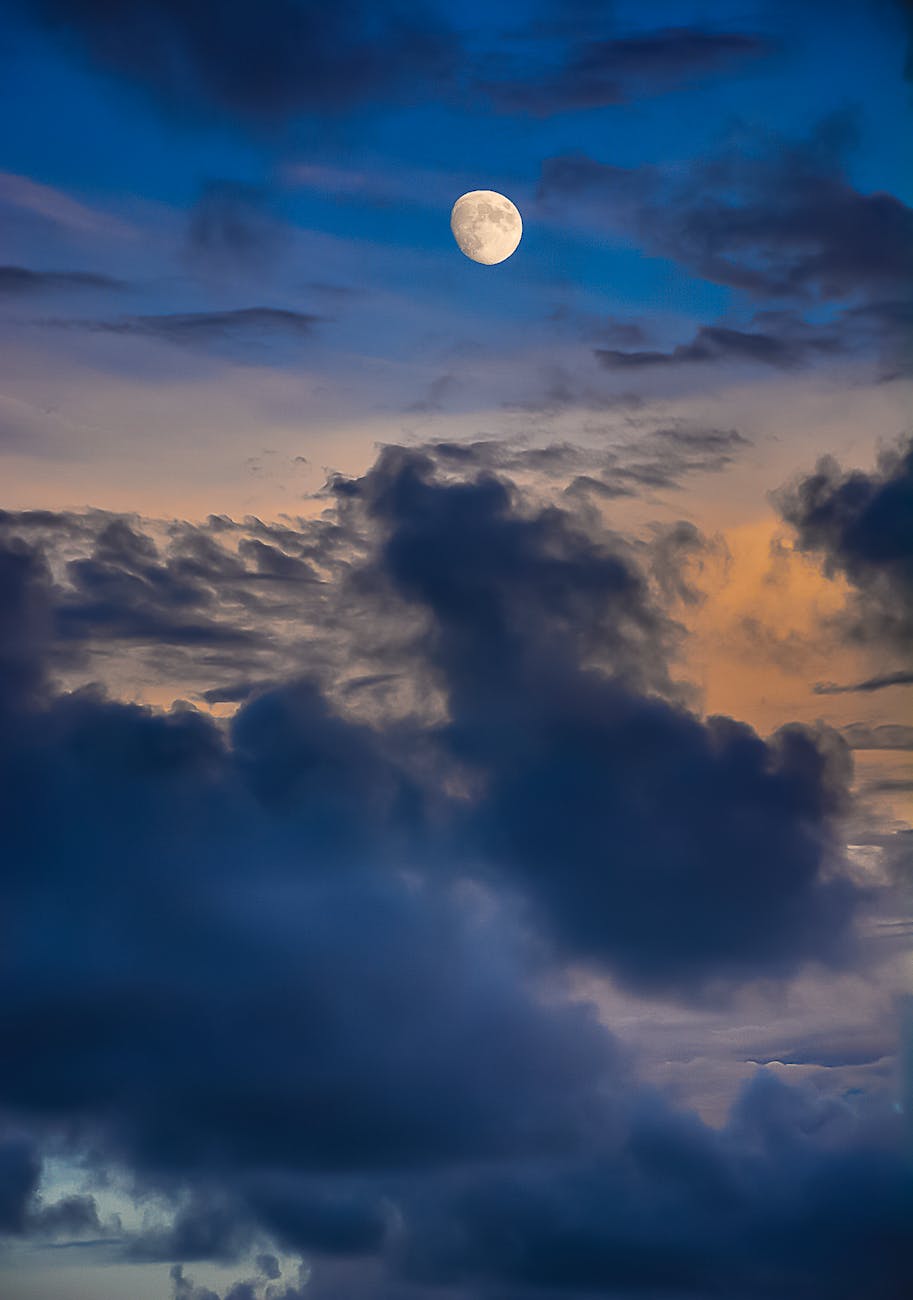
Photo by Reynaldo #brigworkz Brigantty on Pexels.com
Moon Tonightby Gwendolyn Bennet
Moon tonight,
Beloved . . .
When twilight
Has gathered together
The ends
Of her soft robe
And the last bird-call
Has died.
Moon tonight—
Cool as a forgotten dream,
Dearer than lost twilights
Among trees where birds sing
No more.
Find this poem on Poets.org.
This post contains Amazon affiliate links. If you click through and make a purchase, I will receive a small compensation at no extra cost to you. This helps keep my blog ad-free.
Earlier this year I seemed to be running into the theme of edges and margins over and over. People who live on the edges of society. People who live in the margins on purpose to have the life they want. And what plants grow on the edges of fields, gardens, at the side of the road.
At the edge of something a transition can happen. When you get to the edge of your cultivated garden or even a farm field, what we like to call “weeds” grow in these neglected, undernourished places. Cultivation by humans ends here and the wild begins. Nature restores the land as wild by bringing in seeds that grow into plants that improve the soil and hold it in place, and feed native insect and animal species.
People who are part of a community, but feel mostly like they don’t quite fit, are at the edges. They’re the observers of the culture, the ones who see what’s coming, what’s about to change. The loneres, the seers, the oracles, the forerunners, or the Enneagram 4’s, of which I am one.
Earlier this year, watched a documentary about a family who does their best to live by the principles of permaculture (earth care, people care, fair share) and they do the least amount of work in exchange for money/outside jobs so that they can spend more of their time with each other. They gave up a lot of modern conveniences so they can live simply, which means doing a lot of work by hand just to survive. This is important to them, so they’re in the world, but just barely. They’re at the edges. They live a rather uncomfortable life for modern-day humans to stand by their ideals.
When you get to the end of a visit with family, there is that edge that blurs a bit (maybe with tears) as you say goodbye to your loved ones and drive away or watch them do so. I always find it takes me at least a day to acclimate to my usual life and adjust to them not being there, or to my having returned home. There is an edge when I leave them and a transition as I get back into my normal routine. I feel sad, like pieces of myself have gone with them. I’m unsure, out of sorts, and have to work my way through time until I feel more settled in myself.
Edges are uncomfortable and something I would probably avoid if I could. It would be less painful to seamlessly go from one experience to another without that transition, that in-between time. That bump in the road that marks before and after, then and now, this experience and that experience. Is comfort always in our best interest, though? It hurts to grow. It is unsettling to change, to be in-between. Yet we need challenges to change and mature.
I am living in the edges of my spiritual life. I was a charismatic Christian for the first 39 years of my life, albeit a questioning and a bit rebellious one. And then I found I couldn’t accept everything that was taught at face value anymore. I had to leave church. I didn’t fit the mold in many different ways and so I stepped into the wild. It’s been seven and a half years and I’m still in the edges. In the wild places. As I’ve read, pondered, thought, learned about and discussed spirituality from many sources, I’m less certain of some things and more sure of others. For instance, I no longer believe the Divine is exclusive to the Jews and Christians. How could I have even thought that? I used to struggle with those big questions such as:
Until Jesus came and died on the cross so people had a chance to accept salvation, where did those people go when they died?
And before Christ’s time, was it only the Jewish people who could be saved through their constant sacrifices and obeying rules and all the other nations out there went straight to hell because they weren’t Jewish?
And why are Christian people afraid of “Eastern religions”? Where do they think Christianity came from? I mean, I realize it’s been Westernized and even worse, Americanized, but do they really think Jesus was a white man who preached a lot of the stuff one hears in conservative circles today? About property and gun rights and hating certain groups of people because they’re different than us?
I could no longer go along with the idea that because the Bible was written in a time when women were not even considered people, we are still going to follow what is written about women today.
In spite of the fact I’ve parted ways with the church, I still find beauty in some aspects of Christianity. In some of the poetry and prophecies in the Bible; the classical sacred music; some of the liturgy, but that’s where it ends. I am tired of listening to men write books and blog posts about what they think God meant when he said this or that. I am tired of people being afraid of anything that doesn’t have a “Jesus Saves”, “God Bless You”, or “Hallelujah” stamped on it. Of people meeting raw grief, depression, questioning, etc., with a pat verse or cliche instead of sitting with them and holding their hand in their dark night of the soul.
What I am edging into is Celtic spirituality, nature-based, wild, and in the margins. I am searching for more of the sacred feminine in my spiritual experience. I am craving connection with a community yet don’t know if I can deal with the compromises involved in belonging to one. Rachel Held Evans, in her book, Searching for Sunday, admonished readers not to wait for the perfect church or spiritual community because it doesn’t exist. And I know she’s right. I’m just not willing at this point to belong to something that I can’t commit to 100% and that feels completely congruent with the deep, inner places of my heart.
Maybe it’s because I’m still living in the wild places; at the edges and margins of spirituality. I’ve changed so much in the past seven and a half years and will continue to. If you’re living in the margins, in any sense, but especially with your spiritual life, all you can do is keep your heart open; keep seeking, keep listening and asking. God/Goddess/the Divine hasn’t changed. Love hasn’t stopped singing over us and drawing us into an embrace. You are just as loved and just as watched over as those who feel solid in their spirituality. We are all loved, and still precious, still valued, even if we are living in the wild places, at the edges.
The Things That Countby Ella Wheeler Wilcox
Now, dear, it isn’t the bold things,
Great deeds of valour and might,
That count the most in the summing up of life at the end of the day.
But it is the doing of old things,
Small acts that are just and right;
And doing them over and over again, no matter what others say;
In smiling at fate, when you want to cry, and in keeping at work when you want to play—
Dear, those are the things that count.
And, dear, it isn’t the new ways
Where the wonder-seekers crowd
That lead us into the land of content, or help us to find our own.
But it is keeping to true ways,
Though the music is not so loud,
And there may be many a shadowed spot where we journey along alone;
In flinging a prayer at the face of fear, and in changing into a song a groan—
Dear, these are the things that count.
My dear, it isn’t the loud part
Of creeds that are pleasing to God,
Not the chant of a prayer, or the hum of a hymn, or a jubilant shout or song.
But it is the beautiful proud part
Of walking with feet faith-shod;
And in loving, loving, loving through all, no matter how things go wrong;
In trusting ever, though dark the day, and in keeping your hope when the way seems long—
Dear, these are the things that count.
Find this poem at Poets.org
This post contains Amazon affiliate links. If you click through and make a purchase, I will receive a small compensation at no extra cost to you. This helps keep my blog ad-free.
Beechesby David St. John
The forest is its own thanksgiving
Walking a mile or so from the road
Past the lake & ancient post office
I skim the long bodies of the beech trees
The elegant ascension of their slender trunks
A kind of gorgeous illusory play
Of white bars against the dark ochre matting
Of the earth below
Peace is where you find it
As here the last secret of the dawn air mixes
With a nostalgia so perfumed by misery
Only the rhythm of the walk itself
Carries me beyond the past
To say I miss you is to say almost nothing
To say the forest is the sanctuary of ghosts
Is only the first step of my own giving way—
Not the giving up—just the old giving thanks
You can find this poem in The Red Leaves of Night.
This post contains Amazon affiliate links. If you click through and make a purchase, I will receive a small compensation at no extra cost to you. This helps keep my blog ad-free.
A Song For Merry Harvest
by Eliza Cook
Bring forth the harp, and let us sweep its fullest, loudest string.
The bee below, the bird above, are teaching us to sing
A song for merry harvest; and the one who will not bear
His grateful part partakes a boon he ill deserves to share.
The grasshopper is pouring forth his quick and trembling notes;
The laughter of the gleaner’s child, the heart’s own music floats.
Up! up! I say, a roundelay from every voice that lives
Should welcome merry harvest, and bless the God that gives.
The buoyant soul that loves the bowl may see the dark grapes shine,
And gems of melting ruby deck the ringlets of the vine;
Who prizes more the foaming ale may gaze upon the plain,
And feast his eye with yellow hops and sheets of bearded grain;
The kindly one whose bosom aches to see a dog unfed
May bend the knee in thanks to see the ample promised bread.
Awake, then, all! ’tis Nature’s call, and every voice that lives
Shall welcome merry harvest, and bless the God that gives.
You can find this poem inMelaia and Other Poems.
This post contains Amazon affiliate links. If you click through and make a purchase, I will receive a small compensation at no extra cost to you. This helps keep my blog ad-free.
Perhaps the World Ends Here
by Joy Harjo

The world begins at a kitchen table. No matter what, we must eat to live.

The gifts of earth are brought and prepared, set on the table. So it has been since creation, and it will go on.

We chase chickens or dogs away from it. Babies teethe at the corners. They scrape their knees under it.

It is here that children are given instructions on what it means to be human. We make men at it, we make women.

At this table we gossip, recall enemies and the ghosts of lovers.

Our dreams drink coffee with us as they put their arms around our children. They laugh with us at our poor falling-down selves and as we put ourselves back together once again at the table.

This table has been a house in the rain, an umbrella in the sun.

Wars have begun and ended at this table. It is a place to hide in the shadow of terror. A place to celebrate the terrible victory.

We have given birth on this table, and have prepared our parents for burial here.

At this table we sing with joy, with sorrow. We pray of suffering and remorse. We give thanks.

Perhaps the world will end at the kitchen table, while we are laughing and crying, eating of the last sweet bite.

You can find this poem in The Woman Who Fell From the Sky.






 Life of Kim