Plastic: A Personal History
by Elizabeth Bradfield

How can I find a way to praise
it? Do the early inventors & embracers
churn with regret? I don’t think my parents
—born in the swing toward ubiquity—chew
& chew & chew on plastic. But of course they
do. Bits in water, food-flesh, air.
And their parents? I remember Dad
mocking his mother’s drawer of saved
rubber bands and his father-in-law’s red,
corroded jerry can, patched and patched,
never replaced for new, for never-
rusting.
             Cash or plastic? Plastic. Even
for gum. We hate the $5 minimum.
Bills paperless, automatic, almost
unreal.
           My toys were plastic, castle
and circus train and yo-yo. Did my lunches
ever get wrapped in waxed paper or
was it all Saran, Saran, Saran?
                                                Sarah’s mom
was given, in Girl Scouts, a blue sheet
of plastic to cut, sew, and trim with white piping
into pouches for camping. Sarah has it still,
brittle but useful. Merit badge for waterproofing.
For everlasting.
                         You, too, must have heard stories,
now quaint as carriages, of first plastic, pre-plastic.
Eras of glass, waxed cloth, and tin.
Of shared syringes.

All our grocery bags, growing up,
were paper. Bottom hefted on forearm, top
crunched into grab. We used them
to line the kitchen garbage pail.
                                                  Not that long
ago, maybe a decade, I made purses for my sisters
out of putty-colored, red-lettered plastic Safeway
bags. I’d snag a stack each time I went, then fold
and sew, quilt with bright thread, line with thrift store
blouses. They were sturdy and beautiful. Rainproof
and light. Clever. So clever.
                                           I regret them.
And the plastic toothpicks, folders, shoes that seemed
so cheap, so easy, so use-again and thus
less wasteful, then. What did we do before
to-go lids? Things must have just spilled
and spilled.
                      Do you know
what I mean? I mean, what pearl forms
around a grain of plastic in an oyster?
Is it as beautiful? Would you wear it?
Would you buy it for your daughter
so she in turn could pass it down and
pass it down and pass it down?

Find this poem at poetryfoundation.org
Month: March 2022
Evening Poetry, March 10
*This post contains Amazon affiliate links. If you click through and make a purchase, I will receive a small compensation at no extra cost to you. This helps keep my blog ad-free.
Messenger
by Mary Oliver

My work is loving the world.
Here the sunflowers, there the hummingbird—
equal seekers of sweetness.
Here the quickening yeast; there the blue plums.
Here the clam deep in the speckled sand.

Are my boots old? Is my coat torn?
Am I no longer young, and still half-perfect? Let me
keep my mind on what matters,
which is my work,

which is mostly standing still and learning to be
astonished.
The phoebe, the delphinium.
The sheep in the pasture, and the pasture.
Which is mostly rejoicing, since all the ingredients are here,

which is gratitude, to be given a mind and a heart
and these body-clothes,
a mouth with which to give shouts of joy
to the moth and the wren, to the sleepy dug-up clam,
telling them all, over and over, how it is
that we live forever.

You can find this poem in Thirst.

Evening Poetry, March 9

*This post contains Amazon affiliate links. If you click through and make a purchase, I will receive a small compensation at no extra cost to you. This helps keep my blog ad-free.
Small Kindnesses
by Danusha Laméris

I’ve been thinking about the way, when you walk
down a crowded aisle, people pull in their legs
to let you by. Or how strangers still say “bless you”
when someone sneezes, a leftover
from the Bubonic plague. “Don’t die,” we are saying.
And sometimes, when you spill lemons
from your grocery bag, someone else will help you
pick them up. Mostly, we don’t want to harm each other.
We want to be handed our cup of coffee hot,
and to say thank you to the person handing it. To smile
at them and for them to smile back. For the waitress
to call us honey when she sets down the bowl of clam chowder,
and for the driver in the red pick-up truck to let us pass.
We have so little of each other, now. So far
from tribe and fire. Only these brief moments of exchange.
What if they are the true dwelling of the holy, these
fleeting temples we make together when we say, “Here,
have my seat,” “Go ahead — you first,” “I like your hat."

You can find this poem in Healing the Divide: Poems of Kindness and Connection.

Five Non-Fiction Books to Read in March
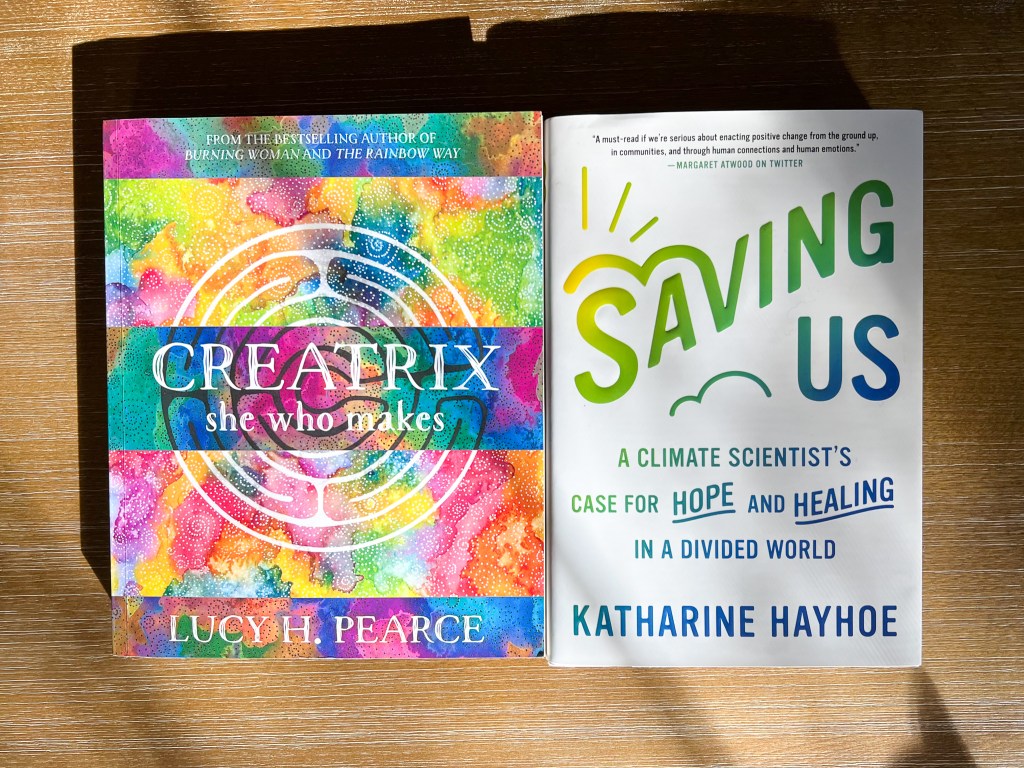
This month I’m hoping to finish up a few non-fiction books I’m meandering through because my TBR is piled super high. And because I’m soaking in the content and learning a great deal.
Creatrix: She Who Makes by Lucy H. Pearce. The author shares personal stories from her own life as well as the voices of many other creative women. What are the joys, the challenges, the highs and lows of creative living. The exhilarating experiences, the slogging through to finish, finding and making time for creative work in the margins of our busy lives. And I haven’t gotten to it yet, but there’s even a practical section about business and marketing. More when I finish the book!
Saving Us: A Climate Scientist’s Case for Hope and Healing in a Divided World by Katherine Hayhoe. This book could also be titled ‘How to Talk to the Deniers, Dismissers, and Those Resistant to Reality’. LOL. But seriously, in only the first few chapters, the author gives clear ideas and examples on how to talk to people about planetary peril, climate catastrophe, etc. I look forward to reading the rest of it.
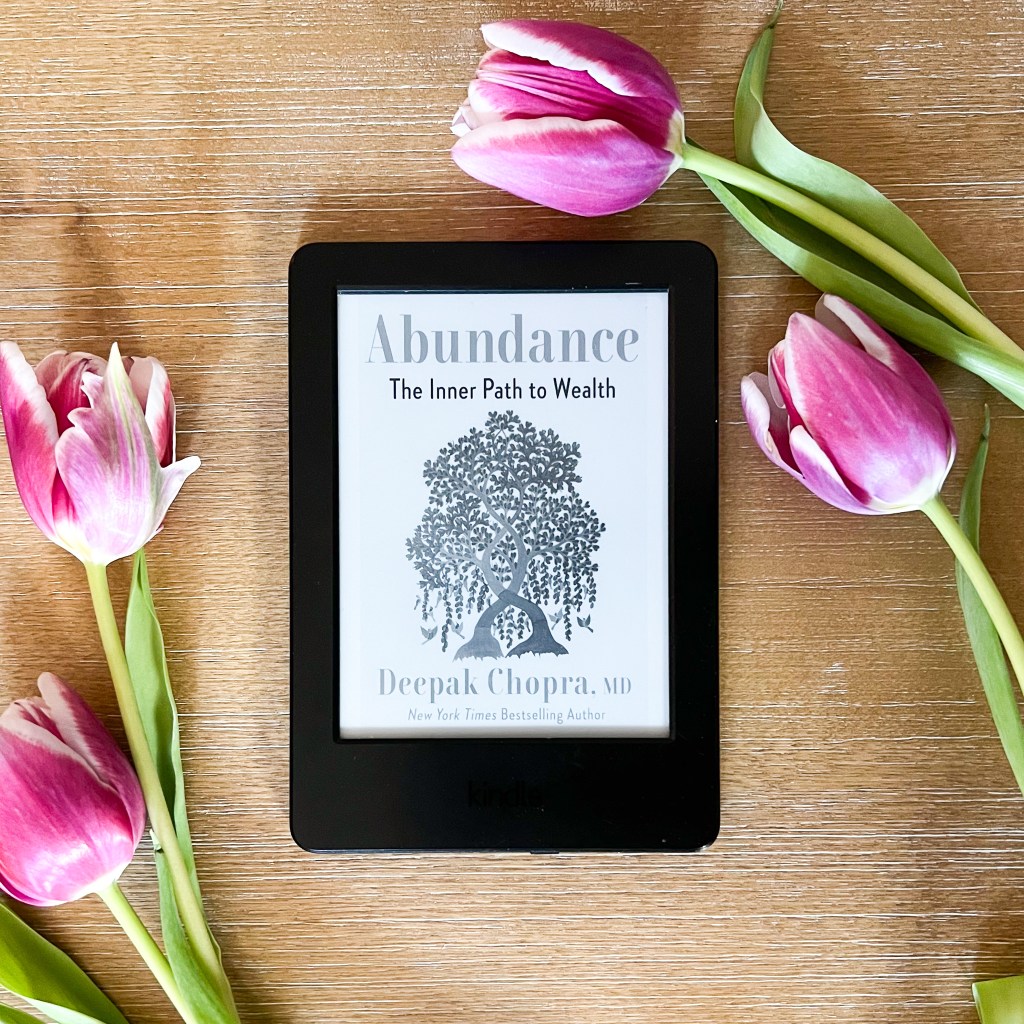
Abundance: The Inner Path to Wealth by Deepak Chopra. With his clear writing, Deepak takes complex concepts and distills them into easy-to-understand and practice principles for living an abundant life. I’ve already had several aha moments. I’m reading through his explanation of the chakra system at the moment and appreciate the way he takes the ‘woo woo’ out of this yogic way of looking at life.
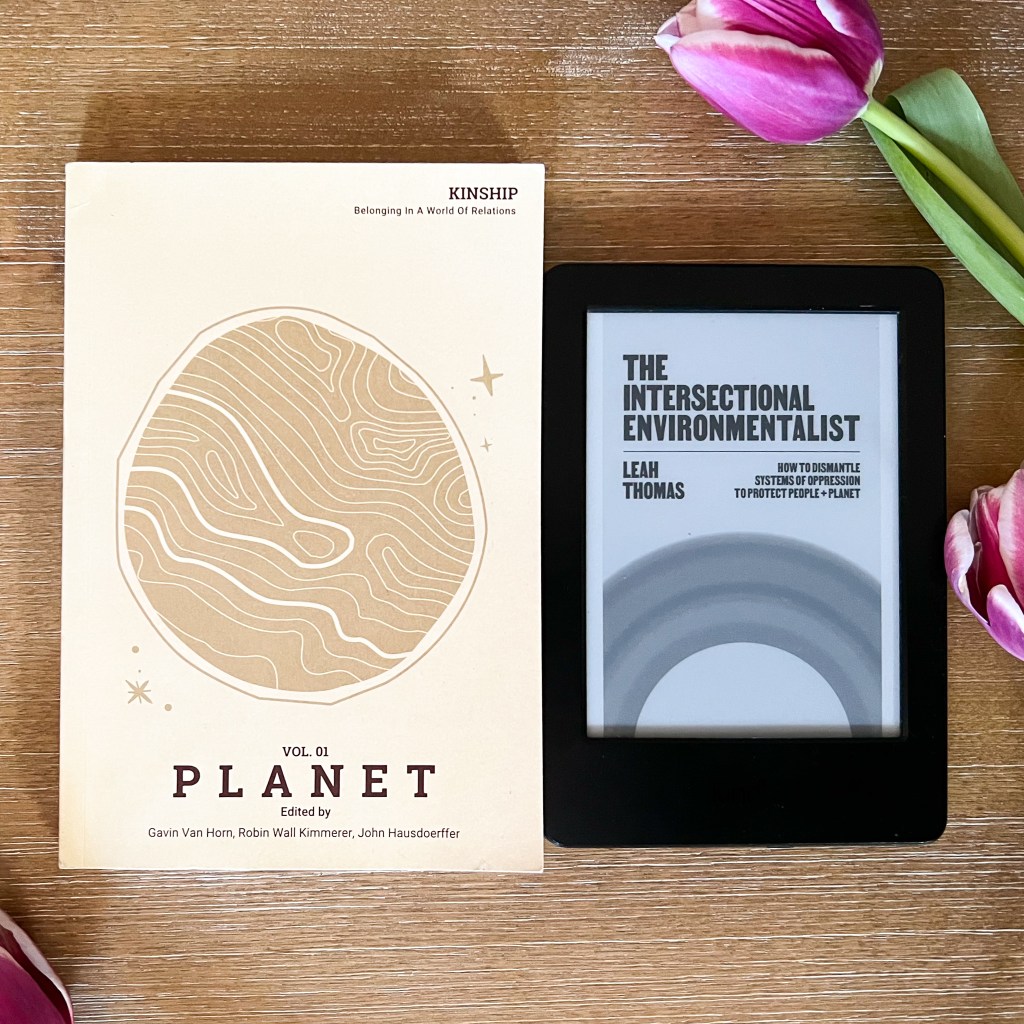
The Intersectional Environmentalist: How to Dismantle Systems of Oppression to Protect People + Planet by Leah Thomas. This book has so much to teach us: from the explanation of terminology of words and concepts such as intersectional, to what has happened and what is happening to dismantle systems of oppression, to what we can do. I am learning so much and can’t wait to read the rest of the book.
Kinship: Belonging in a World of Relations, Volume 1: Planet edited by Gavin Van Horn, Robin Wall Kimmerer, and John Hausdoerffer. All I have to do is see Robin Wall Kimmerer’s name anywhere and I immediately have to read it. This is the first volume of a five volume set from the Center For Humans and Nature. Each piece is thoughtful and beautiful and helps the reader understand even more how we are all connected and related and how what we do matters. I am really looking forward to the piece by Kimmerer as well as the one by Drew Lanham in this volume.
Evening Poetry, March 8
*This post contains Amazon affiliate links. If you click through and make a purchase, I will receive a small compensation at no extra cost to you. This helps keep my blog ad-free.
It’s International Women’s Day! Here is one of my favorite Black woman poets, and perhaps she’s yours too!
Still I Rise
by Maya Angelou

You may write me down in history
With your bitter, twisted lies,
You may trod me in the very dirt
But still, like dust, I’ll rise.

Does my sassiness upset you?
Why are you beset with gloom?
’Cause I walk like I’ve got oil wells
Pumping in my living room.
Just like moons and like suns,
With the certainty of tides,
Just like hopes springing high,
Still I’ll rise.

Did you want to see me broken?
Bowed head and lowered eyes?
Shoulders falling down like teardrops,
Weakened by my soulful cries?

Does my haughtiness offend you?
Don’t you take it awful hard
’Cause I laugh like I’ve got gold mines
Diggin’ in my own backyard.

You may shoot me with your words,
You may cut me with your eyes,
You may kill me with your hatefulness,
But still, like air, I’ll rise.

Does my sexiness upset you?
Does it come as a surprise
That I dance like I’ve got diamonds
At the meeting of my thighs?

Out of the huts of history’s shame
I rise
Up from a past that’s rooted in pain
I rise
I’m a black ocean, leaping and wide,
Welling and swelling I bear in the tide.

Leaving behind nights of terror and fear
I rise
Into a daybreak that’s wondrously clear
I rise
Bringing the gifts that my ancestors gave,
I am the dream and the hope of the slave.
I rise
I rise
I rise.

You can find this poem in The Complete Poetry.

Black Cake (A Book Review)

The new novel, Black Cake, by Charmaine Wilkerson unfolded into a much more complexly woven book than I expected. It starts out with two estranged adult siblings, Benny & Byron, who come together to listen to an audio recording their mother Eleanor left for them after her death.
They haven’t been on speaking terms for years and they can’t wait to get through their mother’s funeral and get back to their lives. When their mother’s lawyer sits them down to listen, their mother reveals one hidden layer of her life after another, stunning Byron and Benny with what she tells them. And the secrets they discover about their mother’s life will change their own.
I loved reading about Eleanor, and her friend, Bunny, as they grew up on the island, and about their lives after they left. Eleanor is really the main character and such a rich, unexpected and beautiful person.
I honestly didn’t like Byron or Benny. Byron is 45 years old, but emotionally is like a 25 year old. And Benny is also immature and self-centered. I can’t imagine not answering my mother’s texts or voice messages for years and years, no matter what happened.
There was such a message of regret through the whole book, which to me said very clearly, “Don’t let this happen to your family!” Life is beautiful and brief. Forgive. Move forward. Let stuff go. Be kind. Love your people. You’ll never regret these actions when you’re at a family member’s funeral.
Read Black Cake, enjoy the story, and may you be encouraged toward love and good deeds.
Evening Poetry, March 7
*This post contains Amazon affiliate links. If you click through and make a purchase, I will receive a small compensation at no extra cost to you. This helps keep my blog ad-free.
Lily
by Ron Koertge

No one would take her when Ruth passed.
As the survivors assessed some antiques,
I kept hearing, "She's old. Somebody
should put her down."

I picked her up instead. Every night I tell her
about the fish who died for her, the ones
in the cheerful aluminum cans.

She lies on my chest to sleep, rising
 and falling, rising and falling like a rowboat
fastened to a battered dock by a string.

You can find this poem in Healing the Divide: Poems of Kindness and Connection.
Evening Poetry, March 6

*This post contains Amazon affiliate links. If you click through and make a purchase, I will receive a small compensation at no extra cost to you. This helps keep my blog ad-free.
Wild Swans
by Edna St. Vincent Millay

I looked in my heart while the wild swans went over.
And what did I see I had not seen before?
Only a question less or a question more;
Nothing to match the flight of wild birds flying.
Tiresome heart, forever living and dying,
House without air, I leave you and lock your door.
Wild swans, come over the town, come over
The town again, trailing your legs and crying!

You can find this poem in The Collected Poems of Edna St. Vincent Millay.

Evening Poetry, March 5
*This post contains Amazon affiliate links. If you click through and make a purchase, I will receive a small compensation at no extra cost to you. This helps keep my blog ad-free.
A Note Left on the Door
by Mary Oliver

There are these: the blue
skirts of the ocean walking in now, almost
to the edge of town,

and a thousand birds, in their incredible wings
which they think nothing of, crying out

that the day is long, the fish are plentiful.

And friends, being as kind as friends can be,
striving to lift the darkness.

Forgive me, Lord of honeysuckle, of trees,
of notebooks, of typewriters, of music,
that there are also these:

the lover, the singer, the poet
asleep in the shadows.

You can find this poem in Thirst.
Evening Poetry, March 4
*This post contains Amazon affiliate links. If you click through and make a purchase, I will receive a small compensation at no extra cost to you. This helps keep my blog ad-free.
Study the Stone
by Meister Eckhart

Be yourself. And if what this means
is unclear to you, look around at

the things of this earth. Study the stone
which always does what it was made

to do: it doesn't always fall in the
same way, sometimes resting in high

places and at other times finding its
rest where the earth allows it to lie,

but its purpose is to move downward,
and in this the stone loves God in the

way it can, singing the new song
which God gives each creature and thing--

and also you who read this at times
wonder what to do and how to be.

You can find this poem in Meister Eckhart's Book of the Heart: Meditations for the Restless Soul.
 Life of Kim